From the Depths of the Mines to Capital Accumulation: Capitalist China Is Built on the Brutal Exploitation of Workers
Every 11 seconds, a wage slave loses their life; each day, more than 6,300 workers ‒ and around 2.3 million working people annually ‒ are driven to their deaths in the killing grounds known as “mines”, “workshops”, “factories”, “production centres”, and “service centres” scattered across the globe.[1]
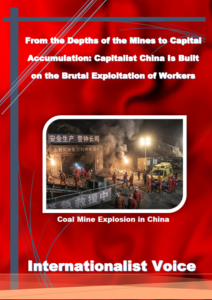
One example of these crimes of the barbaric capitalist system is the disaster at the Liushenyu coal mine in China. On 22 May 2026, following a gas explosion and the collapse of debris, dozens of miners fell victim to the pursuit of profit, while many others were injured. According to reports, the excessive build-up of carbon monoxide ‒ a toxic, odourless gas ‒ was the primary cause of the explosion. This was despite the fact that, at the entrance to the mine, a sign prominently proclaimed: “Safety Is Our Highest Priority”.
This is neither the first such disaster, nor will it be the last. Similar incidents occurred in mines in 2023, 2009, and 2000, claiming the lives of large numbers of miners. In fact, one could compile a long list of workplace catastrophes from recent decades ‒ catastrophes that continue to grow in scale each year.
The fact that a mine previously identified as a site with “serious safety hazards” was nevertheless allowed to continue operating clearly demonstrates that, within the logic of capital, the lives and safety of workers matter only insofar as they do not pose a serious obstacle to the accumulation of profit. The promotional slogans proclaiming that “Safety Is Our Highest Priority”, displayed alongside the lifeless bodies of workers, offer a stark image of the hypocrisy of the capitalist order ‒ an order that, on the one hand, promises “progress” and “prosperity”, while on the other hand buries workers in tunnels of death.
The deadly coal mine explosion in China, which sent dozens of workers to their deaths, was neither a mere “accident” nor simply the result of technical failure; the killing of these miners is a naked expression of the nature of the capitalist system. The workers who perish in the depths of the earth are the direct victims of an order that places profit and the accumulation of capital above human life itself.
Within the logic of capitalism, workplace safety matters only insofar as it does not impose a significant cost on the process of profit-making. For this reason, safety warnings are ignored, standards are lowered, and workers are forced to labour under deadly conditions. The result is the continual repetition of catastrophes that are each time described as “accidents”, while their true roots lie in the mechanisms of exploitation and profit-driven production.
From London and New York to Beijing and Moscow, differences in governments and flags do not alter this reality: under capitalism, the life of the worker is valued only insofar as it serves the production of profit. Whenever the protection of workers’ safety and health comes into conflict with the interests of capital, it is the workers who are forced to pay the price with their lives.
One of the greatest lies promoted by bourgeois propaganda machines in order to shape public opinion is the image of “Chinese communism” and the “communist state of China”.[2] Yet one undeniable reality remains: in China, as in all capitalist countries, the extraction of surplus value from labour power is the principal driving force behind production and the accumulation of capital.
The capitalist mode of production is founded upon the appropriation of workers’ surplus labour. Workers spend part of their working time producing the equivalent of their wages ‒ necessary labour ‒ yet another part of their labour, namely surplus labour, is appropriated by capital without payment and transformed into surplus value and capital accumulation. From this perspective, capital is nothing other than dead labour which, in order to sustain its existence, is compelled to suck living labour like a vampire.
Therefore, whether the political and ideological superstructure of a society is Maoist, Stalinist, fascist, or democratic does not alter the nature of the relations of production. So long as wage labour, commodity production, capital accumulation, and the extraction of surplus value dominate society, what confronts us is a form of capitalism ‒ regardless of the names and slogans attached to it.
China, contrary to the propaganda of nationalism and the left of capital, is neither “socialist” nor in any way connected to the emancipation of the working class. It is one of the principal poles of global capitalism and one of the largest hells of wage labour in the world; a country which, alongside the staggering growth of capital, has also become one of the greatest centres for the concentration of dollar billionaires.[3]
These immense fortunes are the product of the brutal exploitation of hundreds of millions of workers.[4] China’s economic growth, like that of every other capitalist power, is built upon cheap labour, long working hours, the suppression of workers’ protests, job insecurity, and the daily deaths of workers. For this reason, catastrophes such as mine explosions and the deaths of workers are not exceptions but a normal part of the logic of a system that places profit and capital accumulation above human life.
The reality is that the Communist Left not only had not the slightest illusion in Maoism, but regarded it as the product of the defeat of the Chinese proletarian revolution and the victory of the counter-revolution. Although, during the period in which Bilan was published, Maoism had not yet fully developed into the anti-revolutionary ideology it later became, Bilan nevertheless defended class positions that stood in complete opposition to anti-revolutionary policies from the very beginning.
For example, Bilan exposed the mobilisation of workers and peasants into imperialist wars under the banner of “national wars of independence”, regarding them as traps designed to divert the proletariat from its own class struggle. From Bilan’s perspective, the working class must not line up behind any faction of the bourgeoisie, even under the name of “national liberation”, because such wars are ultimately nothing more than rivalries between capitalist powers.
The tendencies of the Communist Left that later presented themselves as continuations of Bilan’s political tradition regarded China as a form of state capitalism; a system that bears no relation to the emancipation of the working class or to genuine socialism. From this perspective, Maoism was not a form of communism, but one of the forms of counter-revolution in the twentieth century which, beneath a “socialist” cover, integrated workers into the framework of national and state-capitalist interests.
The arrest of a few managers or promises of an “investigation into the incident” do nothing to alter the reality of the matter. The issue is not merely the corruption of this or that manager, or the negligence of this or that company; the capitalist system itself is founded upon the exploitation of labour power and the sacrifice of workers’ lives. So long as production is organised not for the fulfilment of human needs, but for profit and capitalist competition, the killing of workers in workplaces will continue.
The answer to these crimes lies neither in appealing to the Chinese state, nor in safety reforms, nor in trade-union and legal remedies. Such solutions, at best, merely seek to contain the destructive effects of the system temporarily, without eliminating the real root of the problem. The source of these disasters lies in the capitalist relations of production and the wage-labour system itself; an order that places profit above human life.
Only the independent and international struggle of the working class against the capitalist system as a whole can put an end to the permanent cycle of death, exploitation, and barbarism. Numerically, the Chinese working class is the largest in the world and, unlike in previous decades, when it was concentrated primarily in the production of cheap commodities, it now plays a fundamental role in some of the most advanced industries and the most modern productive techniques.
Chinese workers, like workers throughout the world, have a common enemy: capital, the states that defend it, and all the institutions and ideologies that reproduce and preserve this deadly order. For this reason, the workers’ struggle cannot remain confined within national borders; rather, it is only through international working-class solidarity and struggle that the possibility of liberation from capitalist exploitation and barbarism can emerge.
Unfortunately, the Chinese proletarian revolution was drowned in the blood of the workers of Shanghai and Canton, and the counter-revolution celebrated its victory over the ruins of working-class struggle under the banner of the “Chinese Mass Revolution”. The defeat of the revolutionary workers’ movement and the bloody suppression of the most advanced sections of the proletariat paved the way for the complete triumph of the counter-revolution and the domination of Maoist ideology.
As a result, those heroic struggles were unable to become a living and enduring tradition within the Chinese working class. On the contrary, for decades the heavy weight of the Maoist counter-revolution cast its shadow over the workers’ movement in China and suppressed every independent class perspective. Under the banners of “socialism” and “people’s revolution”, Maoism poisoned the working class with the ideology of state capitalism and national interests, thereby hindering the development of independent class consciousness.
Nevertheless, the liberation of the Chinese working class from the nightmare of Maoism and the legacy of the counter-revolution will be a difficult and protracted process. Such liberation can emerge only through class struggle and the direct experience of workers’ struggles. Through the course of these struggles, the Chinese working class will be able, step by step, to overcome anti-revolutionary illusions and ideologies, reopen the horizon of independent and revolutionary organisation, and advance alongside the international working class towards a global communist revolution. Only through such a path can the prospect of a classless society founded upon genuine socialism be opened ‒ a society in which the purpose of production is not profit and capital accumulation, but the satisfaction of human needs and the free development of human beings.
The future belongs to the class struggle!
F.A.
28 May 2026
Notes:
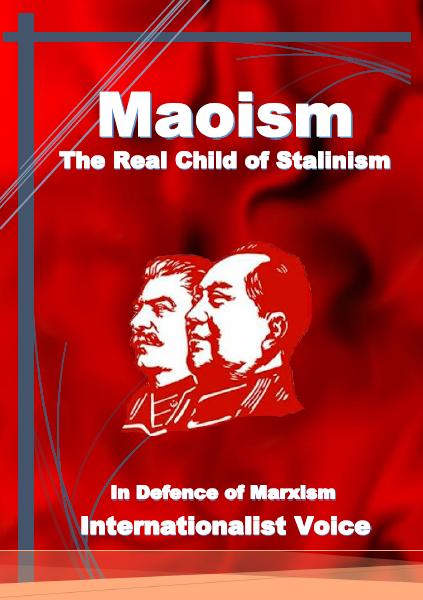
[2] Internationalist Voice has published a booklet entitled Maoism, the Real Child of Stalinism. The booklet examines the background to the defeat of the Chinese Revolution, the manner in which Maoism emerged as the victory of the counter-revolution, and the process leading to the formation of the People’s Republic of China. Reading this booklet is recommended for gaining an understanding of the historical and political roots of Maoism.
[3]The Countries With The Most Billionaires.
[4] Here, our understanding of “brutal exploitation” is not a moral one, but a class analysis grounded in a Marxist perspective. From a Marxist standpoint, the degree of exploitation is measured not by the intensity of the worker’s suffering and hardship, but by the ratio of surplus value to variable capital. In other words, the determining criterion is the amount of unpaid labour that capital extracts from labour power. For this reason, as labour productivity increases and technique and technology advance, the possibility of producing greater surplus value for capital expands, enabling the capitalist to obtain enormous amounts of surplus value. Consequently, even where the outward form of labour changes or part of the physical strain is reduced, the relation of exploitation not only persists but, in many cases, becomes deeper and more extensive.
Download as PDF