The Spectre of Bordiga, or the Spectre of the Communist Left?
“A spectre is haunting Europe — the spectre of Communism.” Marx and Engels opened The Communist Manifesto with these words to show that the ruling classes had already become terrified of the historical prospect of communism, even before it had emerged as a material force. They attributed every radical movement, protest, or idea to “communism” because what frightened them was not an individual or an organisation, but the historical programme of the proletariat and the prospect of abolishing the capitalist mode of production.
Today, albeit on a far more limited scale, it seems that another spectre is haunting the political landscape. It is enough to speak of proletarian internationalism, the political independence of the working class, a critique of parliamentarism, opposition to popular fronts, the rejection of the theory of “socialism in one country”, or a critique of state capitalism for the label “Bordigism” to be immediately attached, as though these positions were not the expression of a historical tradition but merely the views of a single historical militant.
Yet the Communist Left neither began with Bordiga nor ended with him. This tradition emerged from the struggles of the left wing of the communist movement and was forged in defence of the revolutionary programme of Marxism. Following the degeneration of the Communist International and the triumph of the counter-revolution in the late 1920s, as the official Communist Parties were gradually integrated into the camp of capital, it was the Communist Left that upheld the historical continuity of the communist programme, defending proletarian principles against Stalinism, nationalism, every form of the capitalist left, and every form of accommodation with capital.
Without question, Comrade Bordiga was one of the foremost militants of the Communist Left. His significance lay not merely in his role as a theorist or historical figure, but in his uncompromising defence of the historical continuity of the communist programme. One of the defining moments of his political life came during his confrontation with Stalin in 1926. At a time when the Stalinist counter-revolution was tightening its grip on the Communist International, and many leaders of the Communist Parties had either remained silent or acquiesced in this process, Bordiga openly defended the positions of revolutionary internationalism. He rejected the theory of “socialism in one country”, insisted on the necessity of world revolution, and warned that the substitution of the interests of the Russian state for those of the world proletariat would divert the Communist International from its historic course. The significance of this confrontation lay not in a clash between two individuals, but in the defence of the principles and programme represented by the Communist Left.
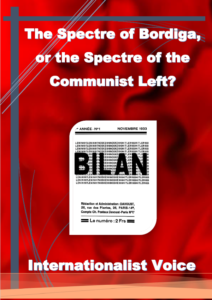
Nevertheless, Bordiga’s own political life demonstrates that the Communist Left cannot be reduced to any single individual or historical figure. During the period when, under the pressure of Fascist repression, he withdrew from direct political activity, the historical continuity of the Communist Left was preserved through the Italian Left Fraction in exile and the publication of Bilan. Bilan was not merely a journal; it represented the theoretical and political continuity of the Communist Left during one of the darkest periods of the counter-revolution. Without the experience and achievements of Bilan, the preservation of this historical continuity would have faced serious difficulties, and a substantial part of the theoretical and political richness of this tradition might have been lost. The experience of Bilan demonstrated clearly that what endures throughout history is not the role of an individual, but the historical programme of communism and the internationalist tradition of the proletariat.
For this reason, reducing every position of the Communist Left to “Bordigism”, or describing such positions as “Bordigist”, explains nothing. Such labels are merely attempts to reduce a historical tradition to the ideas or influence of a single militant. Yet many of the positions that are today dismissed as “Bordigist” are, in fact, historical positions of the Communist Left:
- Defence of the political independence of the working class
- Proletarian internationalism
- Rejection of class collaboration
- Opposition to popular fronts
- Critique of Stalinism
- Opposition to state capitalism
- Opposition to imperialist war
- Critique of parliamentarism
- Insistence that socialism can be realised only on a world scale
What troubles some people, therefore, is not the spectre of Bordiga, but the spectre of the Communist Left. The label “Bordigism” is an attempt to personalise, discredit, and neutralise a tradition that continues to defend the historical continuity of the communist programme while advancing a fundamental critique of capitalism, bourgeois democracy, reformism, nationalism, and every form of class collaboration.
The spectre that must haunt us is not the spectre of an individual; it is the spectre of the Communist Left. It is the spectre of a tradition that, since the degeneration of the Communist International, has represented the continuity of the revolutionary programme of the proletariat and kept the banner of communist internationalism aloft through the most difficult periods of the counter-revolution. If every defence of this historical tradition is still met with the label “Bordigism”, this demonstrates above all that what remains alive, controversial, and unsettling is not the name of Bordiga, but the historical continuity of the Communist Left and its revolutionary horizon.
For this reason, the task of communists, particularly under the grave conditions of the present period, is to defend the historical tradition and communist programme of which the Communist Left has been the standard-bearer and uncompromising defender. Accordingly, all efforts must be directed towards preserving, strengthening, and continuing this historical tradition.
The spectre that must once again haunt the workers’ movement today is the spectre of the Communist Left; a spectre that, through its unwavering defence of proletarian internationalism, the political independence of the working class, and the programme of world revolution, can once again become a material force within the class struggle.
Long live the Communist Left!
A&J
25 July 2026
Download as PDF