The International Labour Organization: A Global Instrument for Managing the Exploitation of Workers
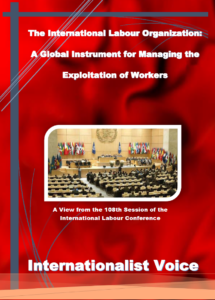
The annual conference of the International Labour Organization will be held in Geneva, Switzerland, from 1 to 12 June 2026. Representatives of governments, employers, and the false “workers’ representatives” from 187 member states will participate in the conference to discuss methods of managing labour power, containing social crises, and ensuring the continued accumulation of capital.
On 5 June 2026, trade unions, human rights activists, leftist groups, and other protesters will also demonstrate outside the ILO conference in defence of workers’ rights, freedom of trade union organisation, the right to strike, and similar demands. They present these actions as part of the class struggle.
For communists, however, such protests are not an independent expression of class struggle, but rather part of the mechanism for containing and controlling it. More precisely, these protests form part of a process through which class struggle is managed and workers’ anger and discontent are channelled into the confines of trade unionism — a process that ultimately legitimises bourgeois institutions responsible for managing labour power in the interests of maintaining the exploitation of workers.
Let us examine the issue more closely: namely, the historical context surrounding the emergence of the International Labour Organization, its function, the role of the trade unions, and the perspective facing the workers’ class struggle.
In the wake of the wave of world revolution that began in 1917, the proletarian revolution in Russia triumphed, while revolutionary movements in other countries — particularly in the heart of Europe, namely Germany — were still unfolding. The expansion of this revolutionary wave generated profound fear within the international bourgeoisie over the spread of communist revolution.
The European bourgeoisie, regarded as one of the most experienced sections of the international bourgeoisie, understood well that confronting communist revolution could not rely solely on unrestrained and violent repression. Experience had shown that “soft repression” often produced more effective and enduring results than direct and overt coercion.
To understand this “soft repression”, it is necessary to consider an important issue: with the outbreak of the First World War, trade unions became integrated into the structure of the capitalist state. At first glance, the mobilisation of workers by the unions in support of the imperialist conflict of the First World War — and even the direct participation of some unions in the repression of workers — may appear sufficient to explain the role of the unions. However, the real function of trade unions in the imperialist era must be understood more deeply, within the framework of the mechanism of “soft repression”.
In other words, by directing and channelling workers’ anger and discontent into trade union channels, the unions create the conditions for the discharge and containment of this discontent, while at the same time preventing the emergence of an independent workers’ struggle based on the class interests of the workers themselves.
It was within this historical context that, in 1919, alongside the Paris Peace Conference and the formation of the new post-war order based on the Treaty of Versailles, an institution was established to manage workers’ demands within a legal framework. During the conference, the “International Labour Commission” was also formed, consisting of representatives from nine countries: Belgium, Cuba, Czechoslovakia, France, Italy, Japan, Poland, Britain, and the United States of America. The commission was chaired by Samuel Gompers, President of the American Federation of Labor (AFL).
The outcome of the commission’s work was the creation of an institution based on “tripartism” — a structure that brought together representatives of governments, employers, and “workers”[1] within a single organisation. Thus, the International Labour Organization was born.
The structure of the International Labour Organization is founded upon the principle of tripartism — that is, the participation of governments, employers, and “workers’” representatives in the decision-making process. However, this structure constitutes a major deception, because the organisations that participate in this framework in the name of workers do not genuinely represent the interests of the working class. Instead, they create the illusion among workers that, rather than organising workers’ struggle for the abolition of the wage system, improvements in the conditions of their wage slavery can be achieved by seating “workers’” representatives at the negotiating table alongside their exploiters.
The International Labour Organization is an institution for the reproduction and stabilisation of the capitalist system. So long as private property and wage labour remain intact, any form of international labour law will merely serve as a mechanism for regulating the extent and conditions of exploitation. The ultimate purpose of such laws is not the abolition of exploitation, but the guarantee of its continuation and the ongoing accumulation of capital.
The International Labour Organization was initially an institution affiliated with the League of Nations. In 1944, as the Second World War was drawing to a close, the organisation adopted the Declaration of Philadelphia, which set out new objectives and orientations for the post-war period. The declaration presented four fundamental principles as the basis of the organisation’s activities[2] — principles which, on the surface, were intended to improve the working and living conditions of workers, but which in practice operated within the framework of preserving and reconstructing the capitalist order after the war.
From this perspective, the provisions of the declaration were not directed towards the emancipation of the working class; rather, they functioned to contain the independent, class-based, and emancipatory tendencies of the workers’ movement. Below, we briefly examine these four principles:
- Labour is not a commodity
The claim that “labour is not a commodity” is not only meaningless, but also a form of demagogy. Under capitalism, what becomes a commodity is not labour itself, but labour power. Labour is the activity carried out in the process of production; it is realised during production after labour power has been purchased and consumed by the capitalist, and it creates new value. Labour power, therefore, is a commodity within the capitalist system — albeit a peculiar one. The distinctive feature of this commodity is that, in the course of work, the worker produces a value greater than the value of their own labour power, and this surplus value constitutes the source of profit in the capitalist system.
- Freedom of expression and of association are essential to sustained progress
Far-sighted capitalism recognises “freedom of expression” and “freedom of association” not out of any commitment to human emancipation, but within the framework of the needs of the capitalist system itself and in order to guarantee its continuation. From this perspective, the formation of trade unions and labour syndicates serves as a mechanism for the management and control of labour power. By recognising trade unions as the official representatives of workers, the International Labour Organization effectively assigns these organisations the role of a “safety valve”.
Through this role, unions are able to contain workers’ anger and discontent within the limits of economic demands and restricted negotiations, channelling them into controlled trade union frameworks. As a result, the independent militancy and combativeness of the working class are restrained, and the possibility of expanding radical struggles against the wage system as a whole is diminished. From this standpoint, the ultimate function of such mechanisms is to prevent the emergence of large-scale workers’ upheavals and, in the long term, to contain the conditions that could give rise to proletarian revolutions.
- Poverty anywhere constitutes a danger to prosperity everywhere
In capitalist society, labour power is a commodity, and the value of this commodity, like that of any other commodity, is determined by the amount of socially necessary labour required for its reproduction. In other words, if capitalism is to employ labour power continuously within the production process in order to sustain the accumulation of capital, it must necessarily provide the minimum conditions required for the reproduction and survival of that labour power.
The reality is that, following the Second World War, average life expectancy increased not only in the capitalist metropoles but also in peripheral countries. This meant that labour power could remain in the service of capital accumulation for a longer period. The raising of the retirement age in the capitalist metropoles can also be understood within this framework — namely, as an attempt to utilise labour power for a longer duration in the service of capital accumulation. For this reason, capitalism was compelled to attach greater importance to the preservation, reproduction, and maintenance of this commodity.
From the standpoint of capital, the unlimited expansion of absolute poverty is not desirable either, since labour power that has become excessively exhausted, starved, and degraded will no longer be capable of meeting the requirements of capitalist production.
- The war against want requires to be carried on with unrelenting vigour within each nation
One of the greatest deceptions and falsehoods contained in this principle is the claim of equality between representatives of workers, employers, and governments — as though these forces occupy equal positions and are able, within a free and democratic environment, to make decisions aimed at advancing public welfare and combating poverty and deprivation. In reality, under capitalism, the state is fundamentally an institution that serves to preserve capitalist relations, and the real balance of power always operates in favour of capital and the ruling classes.
This reality is more evident today than ever before. With the retreat and gradual dismantling of welfare states across many capitalist countries, even within the capitalist metropoles and the so-called “paradises” of the bourgeoisie, large sections of the population now live below the poverty line. At the same time, queues for free food distribution and charitable assistance continue to grow longer by the day. This reality demonstrates that promises of “public welfare” and the “fight against poverty” within the framework of the capitalist order are merely ideological instruments for preserving and perpetuating the barbarism and brutality of the capitalist system.
In 1946, the International Labour Organization officially joined the den of thieves (the United Nations) as its first specialised agency. In 1969, the Nobel Peace Committee awarded the Nobel Peace Prize to the International Labour Organization in recognition of fifty years of efforts to establish “peace” within the class war. From the moment of its formation, this institution has served to contain class antagonisms and to confine the independent struggle of workers within the framework of negotiations between governments, employers, and official trade unions, thereby preventing the expansion of direct class confrontation.
This year’s International Labour Organization conference is being held under conditions in which the barbarism, crisis, and brutality of global capitalism are manifesting themselves more starkly than ever in the form of war, redundancies, job insecurity, poverty, and the widespread devastation of working-class life. Millions of workers across the world are subjected to the pressures of inflation, temporary contracts, privatisation, and direct repression, while facing ever greater economic insecurity and the erosion of social security on a daily basis.
Under such conditions, the official conferences of the International Labour Organization are held neither to put an end to these relations nor even to reduce the intensification of exploitation and misery experienced by the working class, but rather to manage the crises arising from them. The principal function of these gatherings is to preserve economic stability and prevent the spread of social upheaval; in other words, they serve as an attempt to manage labour power and maintain the capitalist order and the prevailing system of exploitation.
The left of capital has played an important role in legitimising the International Labour Organization. French trade unions, together with other labour unions and leftist groups, have called for a demonstration on 5 June in Geneva, outside the annual conference of the International Labour Organization, in order to “condemn the presence of representatives of the Islamic Republic of Iran at the conference”.[3]
This position is a clear attempt at demagogy, as though the other representatives present at the conference were genuine representatives of the working class. From a class perspective, all those who participate in the International Labour Organization under the title of “workers’ representatives” are fundamentally no different from the thugs and hooligans dispatched to the conference by the Islamic Republic of Iran. In the final analysis, all of them operate within the framework of the capitalist order and against the independent interests of the working class.
The left of capital, as in other spheres, performs its role and function effectively. By resorting to the rhetoric of protest and adopting seemingly radical postures, the left of capital, in practice, throws dust in the eyes of the working class and contributes to the strengthening of the democratic institutions of capital. At the same time, by diverting struggle away from class terrain, it obstructs the formation of an independent proletarian struggle and seeks to contain and integrate workers’ protests within the framework of the existing order.
The fundamental question is this: should one not protest? Certainly one should protest — but not from a non-class position, nor through recourse to bourgeois institutions. Protest can only serve the real interests of the working class when it is conducted on class terrain. The streets must be taken over by workers advancing their own independent and class-based demands. Only under such conditions can struggle develop not towards the consolidation of bourgeois democratic institutions, but in opposition to them and as part of the workers’ class struggle.
The emancipation of the working class is possible not through bourgeois international institutions, but through independent organisation and direct class struggle. Historical experience has shown that whenever workers’ struggles have been tied to the legal and diplomatic mechanisms of states, the result has been nothing other than the containment of workers’ radicalism and the integration of protest into the existing order. Even slogans such as “social justice”, within the framework of capitalism, in practice signify the management of poverty and the reproduction of exploitation, rather than its abolition.
The emancipation of the working class is possible not through bourgeois institutions, trade unionism, or the mediation of states, but through independent class struggle, the direct self-organisation of workers within organs of struggle, and the negation of the wage-labour system and capitalism as a whole. The working class cannot achieve its emancipation by placing its hopes in resolutions, international agreements, or the official mechanisms of the existing order. Rather, such emancipation can emerge only through the expansion of class solidarity beyond national borders, the creation of independent workers’ assemblies and organisations, and the organisation of a struggle directed against the entirety of wage relations and the capitalist system. Only through such a struggle does the possibility arise of achieving a society without exploitation, without a class state, and free from the domination of capital.
The future belongs to the class struggle!
F.A.
24 May 2026
Notes:
[1] Of course, by “workers’ representatives” within this structure is meant organisations and institutions that legally operate in the name of workers but which, from a class perspective, are not genuine representatives of the interests of the working class. On the contrary, in practice they operate within the framework of preserving and perpetuating the capitalist order.
[2] Declaration of Philadelphia.
[3] Call for a demonstration in Geneva on 5 June.
Download as PDF