War Flares Up Again in the Middle East: Capitalism Offers Humanity No Future but War and Barbarism
A short while ago, a Memorandum of Understanding (MoU) between the governments of Iran and the United States was signed digitally by Pezeshkian and Trump. The MoU established a framework for the continuation of negotiations, enabling the two sides to reach a final agreement within a maximum of sixty days. At the same time, the bourgeois states and their propaganda apparatuses presented the agreement as a breakthrough in bilateral relations and as a harbinger of peace and stability in the region, even though hostilities and proxy confrontations in various forms continued unabated.
At the time, we argued that this memorandum did not represent the establishment of a lasting peace, but rather reflected a temporary balance of forces between the states concerned. The material foundations of these conflicts remained entirely intact.[1] The rivalry between the imperialist powers over spheres of influence, energy transport routes, markets, geopolitical positions and military supremacy can neither be eliminated by a memorandum of understanding nor resolved through diplomatic negotiations. As long as these material relations endure, the possibility of renewed tensions and war will remain ever present. What changes at such moments is not the nature of these antagonisms, but merely the forms and methods through which they are pursued.
Contrary to the propaganda of bourgeois states and their media, which present every diplomatic memorandum as the beginning of a “new era of peace”, from the standpoint of Marxism and the tradition of the Communist Left such agreements—even when they lead to formal treaties—represent no more than temporary pauses in the ongoing process of imperialist rivalry. Under capitalism, particularly in the imperialist epoch, peace is not the end of war but the continuation of the same rivalries by other means. For this reason, the recent memorandum should be understood not as the end of conflict, but as a brief interlude in a process which, so long as capitalist social relations endure, will inevitably give rise once again to tension, war and barbarism.
Under Article 5 of the memorandum, the Strait of Hormuz was to remain open to commercial shipping, free of transit charges, in both directions between the Persian Gulf and the Gulf of Oman for an initial period of sixty days. At the same time, the memorandum stipulated that the Islamic Republic would hold discussions with Oman and the other Gulf littoral states concerning the future administration of the waterway and the provision of maritime services. This provision left open the possibility of changes to the future transit regime, including the introduction of transit charges or fees for maritime services.
Subsequent developments demonstrated that the Strait of Hormuz is no longer merely a vital commercial shipping route, but has become one of the principal instruments of imperialist rivalry in the region. With the escalation of tensions, the Strait has been transformed from a potential source of leverage into an active instrument of political, economic and military pressure. From this standpoint, the Islamic bourgeoisie’s efforts to strengthen its control over the Strait form part of its broader attempt to enhance its regional position and increase its bargaining power within inter-imperialist rivalries. Likewise, the United States and its allies seek to prevent this strategic leverage from becoming an advantage for Iran.
Within this framework, both sides sought to exercise greater control over maritime shipping routes through military, legal and logistical means, seeking to regulate maritime traffic in accordance with their own strategic interests. As a result, the Strait of Hormuz increasingly became one of the principal flashpoints of confrontation between rival capitalist powers—a confrontation in which global trade, energy flows and even the lives of millions are subordinated to the rivalries of capitalist states.
The Islamic bourgeoisie likewise sought to turn control of the Strait into a lever for strengthening its bargaining position within inter-imperialist rivalries, while preserving the option, should tensions escalate, of threatening to restrict or disrupt maritime traffic. The achievement of this objective would have strengthened Iran’s regional and imperialist position while correspondingly weakening that of the United States and its allies.
To this end, Iran introduced a system requiring vessels to obtain authorisation before entering the designated shipping route. In response, with the backing and pressure of the United States, Oman opened an alternative route through its territorial waters to international shipping in an effort to reduce the effectiveness of Iran’s initiative. Subsequently, the Islamic bourgeoisie declared the Strait of Hormuz closed and attacked vessels using Oman’s alternative route under United States protection.[2]
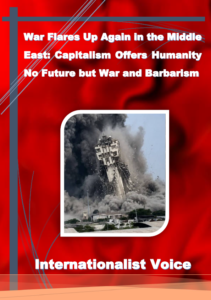
American warmongers launched their bombing campaign against Iran, while the Iranian warmongers attacked United States military bases and the interests of the US and its allies across the region. As the conflict escalated, the war gradually spread beyond purely military targets, drawing critical civilian infrastructure into the imperialist confrontation. In an effort to intensify pressure on the Islamic Republic, the United States expanded its bombing campaign to include bridges, tunnels, desalination plants, water pumping stations, airports and maritime traffic control systems. In response, the Islamic Republic struck targets in Jordan, Kuwait, Qatar, Oman, Iraq and the United Arab Emirates. As the conflict widened, critical infrastructure in these countries—including desalination plants, oil loading terminals and other logistical facilities in Kuwait—also came under attack.
Thus, the conflict has evolved beyond a purely military confrontation into a war against the region’s economic and social infrastructure. This development demonstrates that, in imperialist wars, civilian infrastructure itself becomes a military target, as paralysing an opponent’s economic and logistical capacity becomes one of the principal means of waging war. In such wars, the working class and the labouring masses have no interests of their own at stake. They are not only sacrificed as soldiers on the battlefield but are also forced to bear the real cost of the rivalries between capitalist states through the destruction of the infrastructure upon which everyday social life depends. This is the logic of imperialist war: capitalism, whether in times of “peace” or of war, offers humanity nothing but destruction, barbarism, and the intensification of human suffering.
So far, this war has met with no independent class response either from the working class of the region or, more importantly, from the international working class. The proletariat has largely remained a spectator to this confrontation and has not yet been able, through its own independent struggle, to assert itself as a distinct political force opposed to the rival imperialist camps. This constitutes one of the principal weaknesses of the class struggle at the international level today.
Under such conditions, the task of internationalist communists, and of the Communist Left in particular, is to defend proletarian internationalism unequivocally and to expose relentlessly the imperialist character of this war. This position requires the rejection of any support for the rival capitalist camps, the defence of the political independence of the proletariat, and opposition to all capitalist states, regardless of their form of government, geopolitical position, or ideological rhetoric. At the same time, exposing the nature of bourgeois democracy is an inseparable part of this task, for democracy, no less than any other form of the bourgeois state, seeks to persuade the working class to sacrifice itself in the interests of capital under slogans such as “defending freedom”, “protecting democracy”, or “defending the homeland”.
The communists’ emphasis on the class struggle, the political independence of the proletariat, and opposition to all capitalist states does not stem from a moral or ideological conviction, but from a materialist analysis of the proletariat’s position within the capitalist mode of production. The working class has no interest in the victory of one state over another, for on both sides of the war it is the victim of exploitation, military mobilisation, destruction and slaughter. It follows that only the independent, international struggle of the proletariat can challenge capital’s war machine and create the conditions for bringing the cycle of imperialist wars to an end.
From this standpoint, the end of imperialist wars will come neither through diplomatic negotiations, nor through the intervention of the den of thieves (the United Nations), nor through any other bourgeois institution. The only way to end war is to transform the imperialist war into a class war against capital, to extend the international struggle of the proletariat, and to advance towards world communist revolution. The real alternative to war and barbarism is not bourgeois peace, but the abolition of capitalism, for as long as capitalism endures, war will continue to be reproduced as one of its inevitable forms of existence.
Workers have no country!
Down with the imperialist war!
Long live the war between the classes!
F.A.
18 July 2026
Notes:
[1] For further reading, we recommend the following articles:
- Beyond War and Memorandums of Understanding: Capitalism, the Source of Imperialist War
- War Criminals’ Temporary Ceasefire: an Interlude in the Generalised Imperialist War
[2]The Strait of Hormuz was closed.