Why a Communist Left Identity Rather Than Simply an Internationalist One?
Emphasising a Communist Left identity is not merely a matter of insisting on a name; it expresses an affiliation with a historical and political tradition within the communist movement. The roots of this tradition can be traced to the revolutionary struggles of the early twentieth century, particularly the rise of the wave of world revolution and the repercussions of the Russian Revolution in the years that followed. This current came to be known as the Communist Left, distinguishing its theoretical and political positions from those of other tendencies within the workers’ and communist movements.
To identify with the Communist Left, therefore, does not mean occupying a higher rung on the political ladder of the left; rather, it means upholding a specific historical tradition, its experiences of struggle, and its class and political demarcations.
But why do those who identify with the Communist Left not simply call themselves internationalists? The answer lies in the fact that internationalism, despite its fundamental place in communism, cannot on its own define the identity of a distinct historical and political tendency. Internationalism is a fundamental principle of any revolutionary communist movement, but it does not, in itself, encompass the full theoretical, political and historical content of that movement.
Internationalism: A Fundamental Principle of Communism
Internationalism expresses the fundamental truth that capitalism is a global system and that the working class, irrespective of national borders, stands in opposition to the social and economic relations that underpin this system. The emancipation of the proletariat cannot be achieved within the framework of the interests of a single nation, state or country, because the historical interests of workers in different countries are, at their core, part of the common struggle of the international working class against capital and wage slavery.
Workers in Asia, Europe, the Americas and elsewhere in the world are united not by their national citizenship, but by their class position. For this reason, no section of the working class can separate its own emancipation from the emancipation of the world proletariat as a whole. Defending national interests, supporting one’s own state in inter-imperialist rivalries, or siding with one of the camps of the bourgeoisie is incompatible with proletarian internationalism.
From this perspective, internationalism means more than simply declaring solidarity with workers in other countries; it requires defending the proletariat’s class independence against all states, ruling classes and capitalist camps. This principle is one of the fundamental criteria for distinguishing revolutionary proletarian politics from bourgeois politics, the politics of the left of capital and petty-bourgeois politics.
However, accepting the principle of internationalism is not, in itself, sufficient to determine the political identity of a particular tendency. Currents outside the historical tradition of the Communist Left may also adopt internationalist positions at certain times without sharing the positions of the Communist Left on other fundamental questions of the class struggle. The issue, therefore, is not simply whether a tendency considers itself internationalist, but rather the class and political foundations on which it bases its internationalism and how it upholds that principle in practice.
The Communist Programme and the Internationalist Organisation of the Proletariat
For the Communist Left, internationalism is not merely a theoretical principle or a position on imperialist wars; it must also find expression in the communist programme and in the way the proletariat organises itself. If capitalism is a global system and the emancipation of the working class cannot be achieved within the confines of a single country, then the communist programme cannot be formulated on the basis of a national outlook or the interests of a particular section of the working class. It must express the historical interests and common objectives of the world proletariat and aim at the abolition of capitalist social relations, wage slavery and class society.
For this reason, internationalist organisation is one of the fundamental requirements of the communist struggle. To achieve its emancipation, the working class needs to organise independently and develop an understanding of its own historical and global interests. Such organisation must bring the struggles of workers in different countries together within a common perspective and prevent them from being confined to national demands, competition between states or the interests of different factions of the bourgeoisie. Internationalist organisation does not mean disregarding the specific conditions of the struggle in each country; rather, it means linking these struggles to a common programme and perspective on a global scale.
The communist revolution is also internationalist in its very nature and historical objectives. Since capitalism is a global system, the abolition of capitalist relations and the establishment of a society free from exploitation cannot be confined to a national horizon. The proletarian revolution cannot be reduced to building socialism within the borders of a single country or defending a national state in the name of the interests of the working class. The emancipation of the proletariat requires the worldwide extension of the revolution and the establishment of new social relations that make it possible for humanity to free itself from exploitation and class domination.
There is, therefore, an organic connection between the communist programme, internationalist organisation and world revolution. The communist programme expresses the historical objectives of the proletariat. Internationalist organisation reflects the need to organise the struggle towards the realisation of these objectives, while world revolution defines the historical horizon for their achievement. From the perspective of Communist Left, none of these three elements can be separated from the other two without depriving the struggle for the emancipation of the proletariat of its revolutionary and internationalist character.
Thus, emphasising a Communist Left identity is not merely a declaration of allegiance to a historical tradition; it also expresses a commitment to a specific political orientation: formulating and defending the communist programme, promoting the independent and internationalist organisation of the proletariat, and engaging in the struggle for world revolution. In this sense, internationalism is not merely a theoretical or political position, but a principle that must find practical expression in the aims, organisation and activities of the communist movement.
Why the Communist Left Rather Than Simply an Internationalist?
The term Communist Left answers the question of which communist tradition we defend, whereas the term internationalist primarily emphasises the transnational character of the class struggle and the rejection of any attempt to confine it within national borders. The Communist Left is not merely a generic label for opposition to capitalism or support for world revolution; it is a historical tradition that emerged through struggles within the communist movement and developed specific theoretical and political positions on such questions as world revolution, the relationship between party and class, the state, parliament, trade unions, imperialist wars, fascism and anti-fascism, Popular Front politics, and class alliances.
Referring to the Communist Left indicates how the historical tradition we defend opposed Popular Front politics; how, from a Marxist perspective, it maintained that fascism and anti-fascism are both forms of bourgeois politics within the framework of capitalism, and that, in the imperialist era, the bourgeoisie had become a reactionary class opposed to the proletariat; how it analysed the events in Spain from 1936 onwards not merely as a civil war, but also within the framework of inter-imperialist conflict; and how it regarded the Second World War as an imperialist war. This list can be extended by examining the positions adopted by this tradition on subsequent events and developments, right up to the present day.
By contrast, if a political current describes itself as internationalist, that label alone does not establish what positions it has taken on the issues and developments discussed above. Moreover, adopting an internationalist position on a particular social phenomenon or war does not necessarily imply a firm and consistent commitment to proletarian internationalism.
For example, groups may adopt an internationalist position on the Russia–Ukraine (NATO) war, and describe themselves as “internationalist”. Some anarchist tendencies have adopted similar positions. However, in the wars in the Middle East, particularly the war in Gaza, some of these same groups failed to apply their internationalist principles consistently or to maintain the class independence of their positions in the face of wars and inter-imperialist confrontations.
By contrast, tendencies within the Communist Left, on the basis of the principles of proletarian internationalism and class independence, emphasised the need to adopt a position independent of all imperialist camps and factions of the bourgeoisie.
This distinction shows that adopting an internationalist position on a particular war does not necessarily imply belonging to the historical tradition of proletarian internationalism. A political tendency may adopt an internationalist position on a specific issue without belonging to a tradition that has consistently upheld proletarian internationalism as a fundamental principle guiding its class struggle. The Communist Left, as a revolutionary and proletarian tradition, is inseparable from internationalism and the class independence of the proletariat.
Thus, someone who identifies with the Communist Left may also describe themselves as an internationalist. However, to define their political identity and historical tradition more precisely, they emphasise their affiliation with the Communist Left. In other words, internationalism is one of the fundamental principles of the Communist Left, but it is not, in itself, sufficient to define its historical and political identity.
The Historical Roots of the Communist Left
To understand the identity of the Communist Left, we must return to the historical conditions in which it emerged. One of the major turning points in this history was the First World War and the crisis of social democracy. During the war, a large proportion of social-democratic parties sided with their respective national bourgeoisies, betraying the principle of international solidarity among the working class. They supported their own governments in the war and turned workers into cannon fodder for an imperialist conflict.
In opposition to the betrayal of proletarian internationalism by the majority of social democracy, revolutionaries emerged who insisted on the need to oppose the imperialist war and defend the common interests of workers in the countries involved in the conflict. The Zimmerwald Conference of 1915 was an important arena in which this confrontation unfolded, and its left wing played a crucial role in defending more revolutionary positions against the policy of class compromise. In that historical context, the slogan of turning the imperialist war into a civil war expressed an understanding of the new conditions and the necessity of transforming the struggle against capitalist barbarism into an independent and revolutionary struggle by the proletariat against the ruling class.
The Russian Revolution of 1917 and the revolutionary wave that followed in the years thereafter created favourable conditions for the development of the struggle over the direction of the communist movement. In various countries, tendencies emerged that regarded themselves as defenders of revolutionary communism. These included the Communist Left in Russia, Germany, the Netherlands and Britain, and, in particular, the Italian Communist Left.[1]
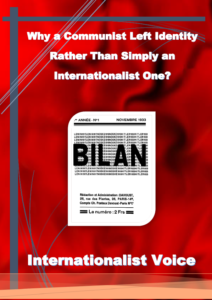
However, these currents were not theoretically or politically homogeneous. Among them, the Italian Communist Left, and the journal Bilan in particular, played a lasting role in preserving and enriching the theoretical foundations of this tradition. Without the experiences and lessons of the Italian Communist Left, the continuity of this historical tradition would have faced considerable challenges. Despite numerous limitations and difficulties, the Italian Communist Left undertook an important historical task and left valuable theoretical and political contributions for subsequent generations of the Communist Left.
Today, the identity of the Communist Left is defined not by affiliation with any particular country, but by its internationalist character. In other words, the Communist Left is a global tradition that transcends national boundaries.
Differences in the views of the various tendencies within the Communist Left on a range of issues form part of the actual history of the Communist Left. Defending this historical tradition therefore does not mean overlooking its internal distinctions and disagreements. The existence of different tendencies is natural, since the development of the proletariat’s class struggle is neither linear nor uniform. Different political tendencies emerge within the workers’ movement in response to diverse historical conditions and struggles.
The fundamental issue, however, is that these theoretical differences and disagreements should help clarify the proletariat’s historical tasks, strengthen its class independence and foster revolutionary convergence. Such convergence can be achieved not by ignoring disagreements, but through theoretical debate and polemic, mutual criticism and a critical reassessment of historical experiences.
Class Independence and Political Demarcations of the Communist Left
One of the central principles of the Communist Left is its emphasis on the self-emancipation of the proletariat. The working class can achieve its emancipation only through its own efforts. This emancipation cannot be brought about by a state, a party acting in place of the class, a supposedly liberating force or a coalition of antagonistic classes. It can be achieved only through the conscious and independent struggle of the working class itself and the revolutionary overthrow of capitalist social relations on a global scale—in other words, through the world communist revolution. In this process, the proletarian class party plays a vital role.
On this basis, the Communist Left emphasises the need for workers’ self-organisation, the development of independent class struggle and the preservation of the proletariat’s political and organisational independence. Particular emphasis is placed on the political and organisational independence of the proletarian class party and its role in the victory of the world revolution. Criticism of class-collaborationist policies and cross-class movements forms an important part of the political tradition of the Communist Left. This criticism stems from a fundamental concern: how can workers’ struggles be prevented from being absorbed into cross-class movements and “all-together” campaigns, incorporated into the mechanisms of the capitalist state or placed at the service of non-proletarian forces?
Following the integration of currents that had once operated under the banner of “communism” into the bourgeois political apparatus, and the emergence of a left wing of the bourgeoisie, the Communist Left has played an important role in defending revolutionary communism by drawing a clear line of demarcation between itself and this wing, which it describes as the “left of capital”. Despite its use of radical language and apparently anti-capitalist slogans, the left of capital operates within the framework of capitalist relations and ultimately contributes to their perpetuation and reproduction.
The fundamental distinction between revolutionary communism—that is, the Communist Left—and the left of capital lies not in the radicalism of their slogans, but in their class content, political orientation and historical horizon. The Communist Left expresses the necessity of an independent working-class struggle to overthrow capitalist relations and abolish all the conditions that reproduce the exploitation of human beings by other human beings. By contrast, the left of capital, as a faction of the bourgeoisie, remains within the bounds of reproducing these same relations. Through its radical demands and slogans, it helps preserve the capitalist system—the very system that the emancipation of the proletariat requires it to overthrow.
The Communist Left: A Historical Tradition Within Today’s Class Struggle
The Communist Left is neither a phenomenon belonging exclusively to the past nor a label that can be used without regard to its political and historical content. Rather, it is inseparably linked to today’s class struggle and, in particular, to the prospect of world communist revolution. The significance of the Communist Left lies in its ability to connect the revolutionary and counter-revolutionary experiences of the workers’ movement with the historical memory of class struggle, making it possible to examine the problems of the present critically in the light of past experiences. The Communist Left serves as a compass in the class struggle, helping to chart the course towards world communist revolution, a struggle that will shape the course of history.
The historical necessity of the Communist Left stems from the continued existence of capitalist relations, class society and wage slavery. As long as the working class remains opposed to capital, and its emancipation depends on the abolition of capitalist relations, class independence, internationalism, the self-emancipation of the proletariat and criticism of bourgeois politics will remain fundamentally important.
The Communist Left represents the critical continuity of the revolutionary tradition of Marxism—a tradition that has fought to defend the proletariat’s historical and political independence against class compromise and the betrayals of currents that once belonged to the communist movement. Defending this historical tradition does not mean claiming that it is immune to error. Rather, it means recognising that, throughout its history, the Communist Left has remained committed to the goal of proletarian emancipation and the struggle to achieve it. It has consistently defended proletarian objectives and opposed subordinating them to the interests of other classes.
The development of the working class is not a linear process. The emergence of different political tendencies within the workers’ movement is therefore part of the historical reality of class struggle. The fundamental question is how these differences are examined through theoretical debate, mutual criticism and, above all, the experience of struggle, and to what extent this process can help clarify the proletariat’s historical tasks. Revolutionary convergence cannot be achieved by ignoring disagreements or imposing a merely formal unity. Instead, it must develop through the clarification of differences, the defence of shared principles and the advancement of independent class struggle.
For this reason, we emphasise a Communist Left identity, because we want to make clear which historical tradition we defend, which experiences of struggle inform our analysis, and on what grounds we draw lines of demarcation against bourgeois politics, deviations within the workers’ movement, and policies that weaken or divert the independent struggle of workers. Internationalism is an inseparable principle of this tradition, but a Communist Left identity encompasses a broader set of historical experiences, theoretical critiques and political positions.
We invite all those whose central concern is the emancipation of the proletariat from wage slavery and capitalist relations to study this tradition critically and participate in theoretical debate and polemic with the various tendencies within the Communist Left. When grounded in reasoned argument, critical examination of historical experiences and the defence of class independence, such debates can help clarify disagreements, deepen theoretical understanding and strengthen the internationalist struggle of the working class. They can themselves form part of that internationalist struggle.
The Communist Left is not merely a label for identifying a political tendency; it expresses a political and historical commitment to world communist revolution, the self-emancipation of the proletariat and the struggle against all forms of subordination of the working class to the interests of capital. Defending this tradition means defending the possibility of human emancipation from class society and the relations of wage slavery. This struggle will retain its historical necessity until that emancipation is achieved.
Internationalist Voice
25 October 2026
Note:
[1]A text of this length cannot examine the Communist Left in Russia, Germany, the Netherlands, Britain, Italy and other countries in detail. Numerous articles and, in some cases, entire books have been published on these tendencies. Studying these works can contribute to a deeper understanding of the history, emergence and development of this historical tradition.
Download as PDF