The Proletariat of the Republic of Azerbaijan Must Reclaim Its Class-Historical Memory
In recent days and weeks, the Republic of Azerbaijan has witnessed protests against restrictions on the wearing of the hijab in schools. Although restrictions on the hijab date back to 2010, the principle of “national character and secularism” was added to the General Education Law in the summer of 2026, and new regulations governing pupils’ dress were adopted in September as part of this framework. Under these regulations, pupils who wear the hijab are barred from attending classes, while teachers who wear the hijab are forced to remove their headscarves to keep their jobs. The government has sought to curb the circulation of news about the protests by restricting access to social media. Dozens of people have also been arrested on charges of participating in actions against public order and damaging infrastructure.
Meanwhile, student protests against the French government’s austerity policies in education have spread to Belgium and subsequently to Italy and Albania. These protests must be examined in the context of rising military expenditure, the burden of a war economy being imposed on society, and the deeper contradictions of capitalist social relations.
The following question may arise: Can the protests in the Republic of Azerbaijan move beyond religious demands and the dispute over the hijab to develop into a broader social struggle against the state and capitalist social relations? Given the existing constraints and the efforts of religious and nationalist forces to steer these protests, the emergence of an independent class struggle appears to be a difficult prospect under current conditions. Nevertheless, the difficulty of such a transition does not diminish the need to raise and examine this question from the standpoint of the proletariat’s class independence.
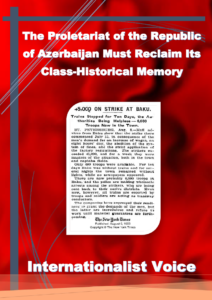
There was a time when the proletariat of Baku, that giant of exploitation, was not dormant but a living and advancing force in the class struggle. During the revolutions of 1905 and 1917, Baku’s workers, as part of the world proletariat, played a prominent role in the struggle against capital. Baku became a symbol of class solidarity: Azerbaijani, Armenian, Georgian and Russian workers stood side by side in factory committees and strikes, fighting capitalist exploitation across ethnic boundaries. Workers’ organisation and the development of proletarian literature and culture were also integral to the life of this class and its struggles. Baku’s experience demonstrated that the strength of the proletariat lies not in religious, ethnic or national identities, but in its unity and independent class struggle.
With the defeat of the global revolutionary wave, this class force also came under the assault of the counter-revolution. By destroying the revolutionary vanguard, the counter-revolution sought to shatter the proletariat’s historical memory and undermine its capacity for self-emancipation. Stalinist repression, including the execution and persecution of communists and revolutionaries, formed part of this counter-revolutionary process. What was presented in the name of socialism and workers’ power led, in practice, to the reproduction of exploitation, the subordination of labour power and the barbarism of state capitalism.
In several Turkish cities, Islamists have gathered outside Azerbaijani diplomatic missions to protest against restrictions on the wearing of the hijab. These protests have once again brought the questions of the hijab, laïcité and the communist position on religion to the fore. The issue is not simply whether to defend or oppose the hijab; rather, it is a question of the class standpoint from which communists approach the matter and how they can resist attempts by bourgeois and religious forces to divide the working class.
Among leftist groups and even feminist movements, two distinct approaches can be identified. The first, invoking the “right to choose what to wear”, regards the hijab as a private and individual matter and emphasises women’s freedom to choose how they dress. The second views the hijab as a symbol of women’s oppression and opposes it from the standpoint of laïcité.[1] From the perspective of the Communist Left, however, the issue cannot be reduced to a choice between these two positions. The fundamental question is this: on what basis should communists formulate their position on the hijab and religion, not only in the Republic of Azerbaijan but also on a global scale?
From a Marxist perspective, religion alone is not the source of women’s oppression, nor does the state prohibition of religious symbols pave the way for women’s emancipation. It is undeniable that the proletariat is not immune to reproducing dominant ideologies, including those underpinning gender, national and racial discrimination. Under capitalist social relations, working-class women face exploitation in the workplace, unpaid domestic labour, and various forms of discrimination and patriarchal domination. Religion can serve to justify and reproduce these relations, but the material roots of women’s oppression cannot be reduced to religious beliefs alone.
The communist struggle, therefore, means neither indifference to gender oppression nor support for either the defence or the prohibition of the hijab. The issue is to defend the independence of the class struggle against the bourgeois state and religious forces. A secular state, too, cannot serve as an agent of women’s emancipation insofar as it reproduces relations of exploitation and class domination. It is the independent struggle of the proletariat that can transform the material and social conditions in which oppression and superstition are reproduced.
The role of schools in capitalist society cannot be reduced merely to the transmission of knowledge and the training of labour power. Alongside their educational function, schools play a role in reproducing bourgeois ideology, training the workforce, and instilling the discipline and values compatible with the capitalist order. In this way, existing social relations are presented as natural and self-evident, thereby establishing the ideological conditions for the reproduction of class domination. The secular character of a school, therefore, does not in itself mean that it has been freed from its class functions.
Bourgeois ideology plays a significant role in dividing and weakening the ranks of the working class by fomenting religious, national, ethnic and racial divisions and reinforcing antagonisms such as secular versus religious and migrant versus native-born. When these divisions take precedence over workers’ common class interests, they become major obstacles to proletarian solidarity and the development of an independent class struggle, ultimately helping to perpetuate bourgeois domination.
The Republic of Azerbaijan is no exception. The emancipation of the proletariat is possible not through the ideological reform of the bourgeois state, but through independent class struggle and the forging of proletarian unity in the course of that struggle. Azerbaijani workers must therefore critically revisit their historical memory and the experiences of previous generations, learn from their defeats and achievements, and take steps towards establishing an independent communist political organisation.
Only through conscious, organised and internationalist struggle can the proletariat resist bourgeois polarisation, overcome imposed divisions and advance its struggle towards the horizon of world communist revolution. The aim of this revolution is to put an end to class exploitation and create the conditions for human emancipation from all forms of oppression.
M.J.
16 October 2026
Notes:
[1] Laïcité is a bourgeois ideology directed against the working class. Historically, laïcité formed part of the bourgeoisie’s struggle to free the state and education from the domination of ecclesiastical institutions. At a time when the bourgeoisie was engaged in a struggle against traditional and religious forces to consolidate the new capitalist order, this struggle played a historical role. However, once the rule of capital had been consolidated, laïcité, as a bourgeois ideology, came to operate against the interests of the proletariat and serve the purposes of class domination, enabling the bourgeois state to preserve the exploitative relations of capitalism.
Download as PDF