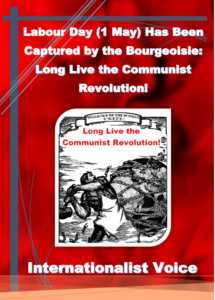
Labour Day (1 May) Has Been Captured by the Bourgeoisie: Long Live the Communist Revolution!
For years, throughout the capitalist world, Labour Day (1 May) has become a stage for the broad presence of the various factions of capital. This day, which has its roots in the independent class struggle of the proletariat, has been captured by the ruling class as well as by the left of capital. These forces, by raising the false banner of defending workers’ interests, seek to disguise the barbaric face of the capitalist system and present it as something tolerable.
Under the cover of seemingly radical slogans and through the instrumental use of the “red flag”, they seek to conceal the reality of wage slavery in modern capitalism. These pitiful annual spectacles, organised in the form of marches and street demonstrations, are nothing but the reproduction of ruling ideology in a deceptive guise. They consciously strive to distort and erase the political and class roots of this day, stripping it of its anti-capitalist and internationalist content, and ultimately turning it into an instrument for the continuation of the very order against which it originally emerged.
In the metropolitan centres of capitalism, the leaders of the trade unions and the social-democratic parties place themselves at the forefront of the 1 May (Labour Day) demonstrations and, by singing The Internationale, present themselves as representatives of the proletariat’s militant tradition. Yet these very same forces, in the real arena of politics, advance and implement the most anti-working-class laws and austerity policies, while at the same time preaching to the working class the necessity of “sacrifice for democracy”.
This apparent contradiction is, in fact, the expression of their material role within the framework of the capitalist order: the containment of class struggle within forms acceptable to capital. In this same vein, the political apparatus of the left of capital, as in the past, functions as an opposition—an opposition situated within capitalist social relations and in defence of its institutions—which seeks to channel the independent struggle of the working class into paths that are harmless to the continuation of the barbaric capitalist system.
In the peripheral countries of capitalism, the left of capital adopts a radical tone and, by advancing demands such as the right to strike, the right to form workers’ organisations, and the like, seeks to take control of the streets. However, this apparent radicalism is, in reality, an attempt to make the defence of the democratic institutions of capital appear more acceptable.
In fact, with the development of class struggle, trade unions become the first bastions and fortifications that the proletariat is compelled to confront and overcome. The experience of independent workers’ struggles and their radical confrontations with both the unions and the capitalist state—particularly in peripheral countries—has shown that what most of all frightens the bourgeoisie and all its right- and left-wing tendencies is the real spectre of the independent class struggle of the working class.
Following the defeat of the revolutionary wave of 1917–1923, which shook the world, Stalinism consolidated its power on the ruins of the October Revolution and on the bodies of blood-soaked communists. Thousands of communists and workers—the very same who had made the October Revolution—were exiled, imprisoned, and massacred.
The defeat of the German Revolution and the massacre of a generation of revolutionaries and vanguards of the proletariat delivered a decisive blow to the world revolution and paved the way for its defeat. Through the repression and physical elimination of the living forces of the revolution—namely the most conscious and militant section of the global proletariat—the bourgeoisie succeeded in depriving the working class of its political vanguard.
The killing of communists and the proletarian vanguard, and the destruction of the independent organs of the working class, disarmed the proletariat of its political weapon and enabled the global bourgeoisie to mobilise the working class under national banners for the mass slaughter of the Second World War.
There was a time when Labour Day was the day of the proletariat’s struggle for communist revolution—a time when the raising of the red flag struck fear into the bourgeoisie and served as a reminder of the historical power of the working class as the gravedigger of capitalism.
However, with the defeat of the revolutionary wave and the triumph of counter-revolution, this day—like many other political gains of the proletariat—was captured by the bourgeoisie. Since then, the bourgeoisie has sought to strip 1 May of its revolutionary and class content and to turn it into an instrument for defending its own interests: a means of poisoning workers’ class consciousness and integrating them into the capitalist order.
The historical defeat of the proletariat in the late 1920s marked the beginning of the dark period of counter-revolution—a period that demonstrated that the working class had, temporarily, been defeated by capital. Stalinism, fascism, and bourgeois democracy each, in different ways, functioned as instruments of this global counter-revolution.
In the 1930s, in a context in which the Third International had completely broken with proletarian positions and had become an instrument in the service of Russian state capitalism, only the Italian Communist Left fraction was able to defend internationalist principles and communist positions. From that point on, the real continuity of the communist tradition was not expressed in the currents of the left of capital, but in the currents of the Communist Left.
The Communist Left, as the historical continuation of revolutionary Marxism, preserved the invincible banner of class struggle and the perspective of the world revolution of the proletariat.
After the Second World War, the bourgeoisie believed that it had permanently defeated the proletariat and eliminated the danger of communist revolution. Intoxicated by its military victory and the relative post-war prosperity—prosperity built on the ruins of war and on the slaughter of millions of workers during the Second World War—capitalism proclaimed the end of its historical crises and the permanence of its own order.
This illusion was based on the heavy defeat of the proletariat in previous decades and the long period of counter-revolution—a period in which Stalinism, bourgeois democracy, and fascism, each in different ways, kept the working class trapped within the framework of the capitalist order. The bourgeoisie believed that the working class would no longer return to the stage as an independent historical force.
However, May 1968 shattered this illusion. Millions of workers, particularly in France and simultaneously on an international scale, demonstrated through mass strikes and struggles that the proletariat was still alive and remained the only class capable of challenging capitalism. The bourgeoisie has consistently sought to reduce the general strike of May 1968 to a “student revolt” in order to obscure the historical role of the working class. Undoubtedly, the student movement was part of the social atmosphere of that period, but the real force that shook the bourgeoisie was not the students, but the general strike of millions of workers—the very force that once again brought the possibility of the return of class struggle and the perspective of proletarian revolution to the centre of history.
This new wave of class struggle demonstrated that the proletariat had overcome the historical weakness of the counter-revolutionary period and had once again returned to the stage as an independent social and political force. May 1968 was not merely a momentary explosion, but the beginning of a new period of class confrontation—a period in which the contradiction between labour and capital once again emerged in an open and expanding form.
The result of this return was the expansion of workers’ struggles across the world throughout the 1970s and 1980s. Widespread strikes, mass struggles, and resistance to capital’s attacks showed that the proletariat, despite past defeats, had no option but to defend its class interests and continue its struggle against capitalism. The working class once again asserted itself as a real threat to the capitalist order.
This reality was a decisive response to all ideologies that proclaimed the historical end of the proletariat—views that either regarded the working class as “bought off” and integrated into capital, or denied its very existence altogether.
In contrast to sterile and deviationist interpretations such as councilism, modernism, and other tendencies which either deny the role of a revolutionary political organisation or reduce the historical task of the proletariat to superficial sociological observations, Marxism remains alive as the revolutionary theory and methodology of the proletariat.
It is this theoretical continuity that has enabled revolutionaries to keep the historical task of the working class—the destruction of capitalism—at the centre of their political struggle:
“It is not a question of what this or that proletarian, or even the whole proletariat, at the moment regards as its aim. It is a question of what the proletariat is, and what, in accordance with this, it is historically compelled to do.”[1]
The collapse of the Eastern Bloc was not the result of proletarian revolution, but rather the product of the internal crises of state capitalism and the inability of Stalinism to compete with the Western Bloc. The Stalinist regimes, which themselves were a form of capitalism and an instrument of counter-revolution against the working class, did not fall at the hands of the proletariat but under the pressure of their own economic, political, and military contradictions.
This reality enabled the global bourgeoisie to organise a vast ideological campaign. Since Stalinism did not collapse through a workers’ revolution but in competition with bourgeois democracy, democratic illusions within the working class were strengthened and its class consciousness became further confused. The bourgeoisie sought to present the victory of bourgeois democracy over Stalinism as the triumph of the “free world” over “totalitarianism”.
The aim of this ideological operation was clear: to convince the working class that every revolutionary effort, every perspective of overthrowing capitalism, and every idea of radically transforming this inverted world was already doomed to failure. By launching the global campaign of the “death of communism”, the bourgeoisie sought to bury the historical possibility of communism.
Yet once again, it was the Communist Left that stood against this historical falsehood and declared: what collapsed was not communism, but one of its most violent enemies—Stalinism. Communism was never confined to Moscow or to the party-state forms of state capitalism; it has survived in the continuity of the proletariat’s independent and internationalist struggle against all forms of capitalism.
In the current conditions, and given the destructive role of the left of capital in creating confusion within the process of class struggle and, consequently, obstructing the working class’s attainment of its class identity, the responsibility of the Communist Left becomes even greater.
For this reason, the defence of the very necessity of a militant communist political organisation is a historical imperative. Efforts to prepare for the formation of a world proletarian party and a communist international are an inseparable part of this task. This organisation will be the essential weapon of the working class for the conscious unification of its global struggle and the political condition for the victory of the communist revolution.
Capitalism smells of blood, filth and slime. Capitalism means war, crisis and misery. This system is based on the exploitation of labour power and the ruthless competition between capitals, and in its historical period of decline it has brought humanity nothing but destruction, poverty and barbarism.
War is not a temporary deviation, but an inevitable product of capitalism’s internal logic. Today, capitalism has spread war to every corner of the globe, and workers everywhere are turned into cannon fodder in imperialist wars. But this is not limited to countries directly involved in war; the war economy is imposed by all capitalist states across the world. The cost of these wars is borne by the working class through austerity, mass redundancies, wage cuts, inflation, and intensified exploitation.
In the face of this situation, the working class must, as an independent social force, enter into an independent class struggle and fight solely for its own historical and class interests. The struggle against wage slavery, exploitation, unemployment, redundancies, poverty and inflation can open up a liberating horizon for the working class, as it targets the very foundations of the capitalist system itself.
Only in such a process can the proletariat transform imperialist war into a war against capitalism itself; a perspective that the communist left has always set against the barbarism of capitalism.
The working class is the only social class that can bring an end to capitalist barbarism, poverty, war and destruction. No class in history has borne such a vast and universal responsibility. Today, more than ever, the future of humanity lies in the hands of the proletariat’s class struggle.
There is only one solution: the destruction of the capitalist system, before it drags humanity into total ruin. The alternative that communists have long put forward is, today more than ever, of vital relevance:
Communist Revolution or the Destruction of Humanity!
Internationalist Voice
24 April 2026
Note:
[1] Marx, The Holy Family, Chapter IV
Download az PDF