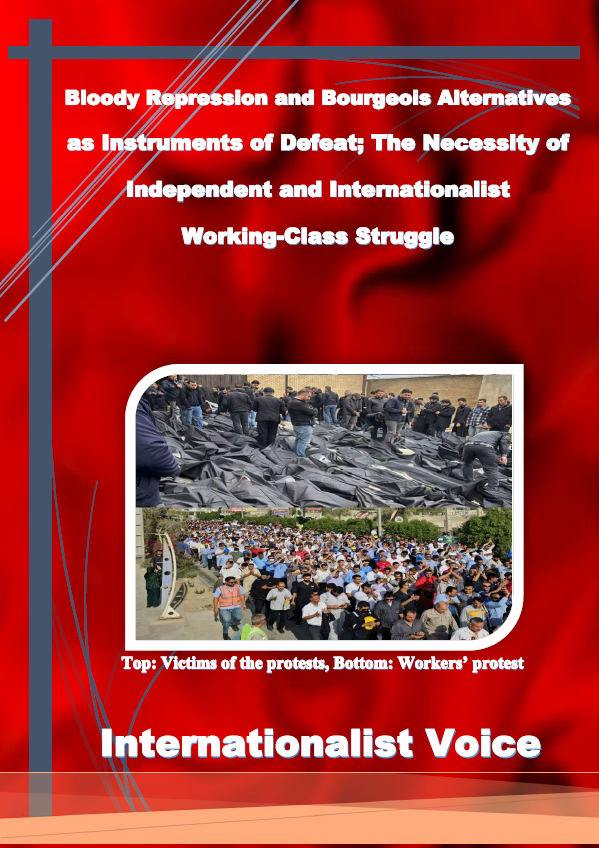
Bloody Repression and Bourgeois Alternatives as Instruments of Defeat; The Necessity of Independent and Internationalist Working-Class Struggle
Table of Contents
- Introduction
- Bloody Repression
- Could the massacre have been prevented?
- The Imperialist Project to Contain the Islamic Bourgeoisie
- Propaganda and Media War
- The National Revolution: A Bourgeois Project Against the Working Class
- Bourgeois History-Making Versus the Tradition of Class Struggle
- The Left of Capital
- The Intensification of Class Struggle Is the Only Horizon
- Basic Positions
Introduction
The new wave of protests in Iran began on 28 December 2025, following a sharp depreciation of the national currency against foreign currencies. It rapidly spread to other cities and took on the character of anti-government demonstrations. The material roots of these protests lay in widespread dissatisfaction with the henchmen of the Islamic bourgeoisie, and at the same time they assumed the form of a broad-based “all-together” popular movement.
However, the “all-together” character of the protests creates space for reactionary forces to enter. For this reason, monarchists, ultra-reactionary elements and adventurists were able to participate in these protests and play their part. A clear example was the son of the Shah’s executioner, who, acting as a proxy for Israel, issued a call at 8 p.m. on 8 and 9 January and, referring to the possible retreat of the repressive forces, predicted their defection. The outcome, however, was brutal and widespread repression, and no such defections occurred.
From the perspective of the communist left, the key question is how similar massacres can be prevented and how the traps laid by the bourgeoisie and the security apparatus can be neutralised. The history of the workers’ movement has shown that success is possible only when the vanguard of the working class acts with political maturity and class consciousness, keeping in view not merely the immediate and emotional upsurges of the movement but the long-term objectives of the proletariat.
For example, in July 1917 in Russia, when segments of the workers and soldiers were ready for a premature confrontation with the ruling power, the Bolsheviks, by understanding the balance of forces and avoiding adventurism, prevented the movement from being drawn into an untimely clash. This experience demonstrates that recognising the right moment and maintaining a strategic horizon are vital to avoid defeats and bloody repression.
The experience of January 2026 once again showed that the more protests rely on an independent working-class front and struggle from below—led by the workers themselves and guided by the conscious vanguard of the class as a compass—the more protected they are from the traps and interventions of capitalist forces and security institutions, and the greater their capacity for sustaining and expanding the struggle. Class independence and organisation from below are essential conditions for transforming scattered anger into a conscious and enduring force.
In a situation where the right and left tendencies of capital are each playing their respective roles, and even dark forces, imperialist proxy gangs, and adventurist elements are acting to distort the political landscape and divert struggles, the responsibility of the communist left is heavier than ever: to provide a clear analysis of events from an internationalist perspective, to emphasise the independent working-class movement, and to organise struggle from below through instruments such as workers’ committees, strike committees, neighbourhood committees, general assemblies, and other collective mechanisms.
Only when the working class itself takes the leadership of the struggle and mobilises the lower strata of society behind it can the interference of reactionary forces—whether within the state or in the opposition—be minimised. Under such conditions, the workers’ movement can, through a continuous and conscious process, be elevated to a higher level of organisation and political capacity, pursuing its historical horizon with greater clarity.
Download the booklet as a PDF