Neither War nor Peace: Negotiations and Warfare Side by Side; Imperialist Tensions as a Product of Capitalist Relations
The mainstream media are giving the impression that some form of ceasefire is in place between the warmongering forces in the Middle East – a situation that can be described as neither war nor peace. But the reality is quite different: alongside the negotiations, the war continues on both military and economic fronts.
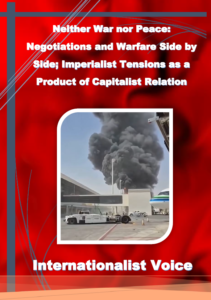
The Houthis have not only made advances in Yemen but have also targeted key Saudi economic, commercial and oil facilities, as well as airports. The headquarters tower of Saudi Arabia’s Public Investment Fund, a symbol of the country’s financial district, has been hit repeatedly, while Riyadh Airport has been forced to close for days. Meanwhile, Saudi Arabia continues to conduct military operations in Yemen on a daily basis.
American warmongers, too, bomb southern Iran from time to time, while Iran has repeatedly targeted Bahrain and Kuwait in recent weeks. The Strait of Hormuz has become one of the key flashpoints in this war. On the one hand, American gangsters, backed by air power, escort ships through the strait like smugglers; on the other, Iranian gangsters attack one or two ships almost every day. Last October also saw the highest number of attacks on ships since the current war in the Middle East began.
Israel continues to conduct military operations in Lebanon and Gaza, and the killing continues. In other words, the military conflict is not confined to a single location but is unfolding across the entire Middle East. At the same time, Qatar and Oman are acting as mediators in negotiations between the Iranian and American gangsters.
Alongside the military conflict, the economic war is also continuing unabated – a war whose costs and consequences fall, first and foremost, on ordinary people. The United States, acting as the world’s sheriff, initially imposed a naval blockade on Iran and then turned to an air blockade. This means that any country providing services to Iranian aircraft risks being subjected to US sanctions itself.
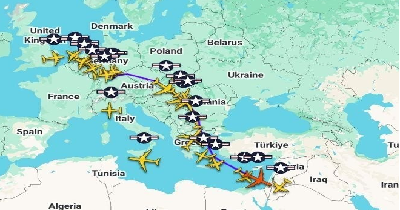
Finally, in an attempt to squeeze the life out of Iran’s economy and force its criminal rulers to accept the agreement it wants, the United States has also set its sights on imposing a land blockade, putting Turkey, Iraq, Pakistan and other neighbouring countries under pressure. As a result, two border crossings on the Iraqi side have been closed. Pakistan’s border crossings, although still open, have been subjected to restrictions, while increased inspections of lorries at the Turkish border have led to longer waiting times and traffic congestion.
US Secretary of State Marco Rubio, explaining this imperialist policy, said:
“If we can achieve the same objective through economic tools and economic pressure, there is no need for military strikes. This is not a stalemate.”[1]
The US naval blockade has dealt a severe blow to Iran’s oil exports. By contrast, other oil-producing countries in the region have managed to restore a significant proportion of their exports, either by using alternative transportation routes or with US support. However, the costs of the war and the economic blockade are not confined to Iran’s peripheral capitalist economy, which is on the verge of collapse, or to the rial, whose value is in free fall.
Capitalism is a global system, and the consequences of the war in the Middle East have not been confined to the parties directly involved in the conflict. The global economy, and the Gulf countries in particular, have been severely affected by the war. Allianz, the insurance and financial services company, estimates that the physical damage caused by the war in the Gulf countries has exceeded $200 billion, while their combined loss of economic output is expected to reach approximately $790 billion by 2030. According to the report, more than 80 energy facilities have been targeted, around a third of which have sustained serious damage.
Qatar, Kuwait and Bahrain are more vulnerable because of their greater dependence on the Strait of Hormuz. Saudi Arabia and the UAE, by contrast, are in a relatively stronger position thanks to their alternative oil transportation routes. Nevertheless, the crisis extends well beyond energy exports. Tourism, aviation, maritime transport, trade and property markets have all been affected. Most importantly, these countries have lost their image as safe and stable destinations for investment and economic activity – an image that has long been one of the foundations of capital attraction and wealth accumulation in the region.
The International Energy Agency (IEA) has also warned in its annual report that the crisis in the Middle East and the closure of the Strait of Hormuz have created the greatest threat to global energy security in history. According to the agency’s assessment, the scale of the crisis has surpassed even that of the oil shocks of the 1970s. Disruptions to oil exports, rising prices and reduced supply have placed enormous pressure on consumers and will have long-term consequences for the global energy market.
The fundamental point is that even an easing of the war would not mean that the global economy – particularly the economies of the countries in the region – could quickly return to pre-war conditions. The political, economic and security consequences of this war will persist for years, even if the military hostilities come to an end. Their effects will be felt not only in Iran and the countries of the region, but also in the United States, Israel, Europe and the global economy as a whole.
Moreover, economic pressure from the United States and its allies will not necessarily force the rulers of the Islamic bourgeoisie to retreat; indeed, such pressure could well lead to an escalation of the conflict. Despite military attacks by the United States and Israel, the support they have received from European countries and their regional allies, and the serious damage inflicted on its military infrastructure, the Islamic bourgeoisie still retains considerable missile and drone capabilities. More importantly, the rulers of the Islamic Republic have adopted a strategy of asymmetric warfare, which enables them to widen the scope of the conflict, intensify tensions and impose costs on their opponents.
It is in this context that the rulers of the Islamic bourgeoisie speak of abandoning geographical restrictions on military retaliation and widening the scope of the confrontation. In other words, whereas previously we were facing an escalation of tensions within the framework of a regional war, the danger now is that the conflict could spread beyond the boundaries of the Middle East. Mohammad Bagher Ghalibaf, Speaker of the Islamic bourgeoisie’s parliament and head of its negotiating delegation with the United States, has issued the following warning:
“This time, if the Americans make a mistake, the geography of the battlefield will be determined by the capabilities and resolve of Iran’s armed forces… The fallout from a new war will affect many.”[2]
Against the backdrop of shifts in the balance of power at the highest levels of the ruling establishment, and particularly amid the conditions of war and disagreements over negotiations with the United States, the Islamic bourgeoisie has sought to prevent an excessive concentration of power in Ghalibaf’s hands. To this end, it has brought Mohsen Rezaei, a former senior commander of the Islamic Revolutionary Guard Corps (IRGC), back from the sidelines to the centre of decision-making, appointing him Secretary of the Supreme National Security Council.
Rezaei has recently declared that the Islamic Republic is determined to break Iran’s blockade, a move that, in practice, would be impossible without widening the scope of the confrontation. He has also stressed that any new attack will be met with an all-out response:
“The armed forces and the institutions of the ruling establishment are determined to break the blockade and will respond to any new attack with full force.”[3]
Within the United States itself, the Trump administration’s warmongering policies and the continuation of the war in the Middle East are also facing opposition from a considerable section of public opinion. The results of the midterm elections and the Republicans’ defeat have brought divisions within the Trump administration over the war with Iran into sharper focus. In his assessment of the Republicans’ electoral defeat, US Vice-President JD Vance identified the war with Iran as one of the main factors behind it. The significance of his remarks lies in the fact that opposition to the imperialist war is no longer confined to critics of the administration; it has also become apparent at the highest levels of political power in the United States. The continuation of the war has thus become a contentious issue within the US ruling establishment.
The results of the US midterm elections have also raised serious concerns within Israel’s ruling establishment. Growing criticism of Netanyahu’s policies among Democrats and even sections of the Republican Party indicates that unconditional US support for Israel no longer enjoys the same degree of political consensus within the American ruling class as it once did. One indication of this shift is Trump’s remarks about the possibility of bringing forward the termination of the United States’ annual $3.8 billion military aid package to Israel.
This once again highlights the structural dependence of Israel’s war machine on US military and political support. Jacob Katz also points to the consequences of this dependence:
“Our entire Air Force is American-made military planes, we’re dependent on American spare parts and American weapons. The last three years have shown us how dependent we are on American missile-defence systems.”[4]
A reduction in US military aid, or even a slowdown in its delivery, could alter Israel’s military, security and even economic calculations. Israel’s war machine does not require the direct support of its allies to carry out occasional, limited attacks against Iran. However, launching and sustaining an all-out war against Iran depends on comprehensive support from the United States and its other allies. Without such support, Israel’s capacity to wage and sustain a large-scale war against Iran would be severely constrained.
Each imperialist power seeks to advance its own imperialist interests, and developments in the Middle East have different implications for each of them, in accordance with this same logic. Tensions in the Middle East have, at least in certain respects, served Russia’s imperialist interests. Disruptions to shipping in the Red Sea, the closure of the Strait of Hormuz and rising oil prices all boost Russia’s oil revenues. Moreover, US involvement on a new front diverts Washington’s resources and attention away from the war in Ukraine.
By contrast, the continuation of tensions in the Middle East is, on the whole, at odds with China’s economic and strategic interests. China sources a significant proportion of its imported oil from the Middle East. Disruptions to shipping through the Strait of Hormuz, rising transport and insurance costs, and higher oil prices directly affect China’s energy costs and industrial production. Increases in the prices of oil, gas, petrochemical products and transport can raise the production costs of Chinese goods and undermine the competitiveness of the country’s industries. Furthermore, in recent years, China has made extensive investments in the countries along the Persian Gulf, particularly in the energy, infrastructure, technology and port sectors. Regional instability could also jeopardise the security of these investments and Beijing’s long-term plans.
At a time when Trump, Putin and Xi Jinping were holding a trilateral meeting in Shenzhen, China, on the sidelines of the APEC summit, with the media spotlight firmly fixed on the gathering and its portrayal as a historic event yielding historic achievements, the ambassadors of Iran, Russia and China to the International Atomic Energy Agency (IAEA) simultaneously issued a joint statement. They described the military attacks on Iran and its nuclear facilities as violations of the United Nations Charter and threats to the Agency’s monitoring activities. The three countries also declared that the resumption of the IAEA’s monitoring activities should be conditional upon a complete cessation of hostilities, the removal of the threat of further attacks, and guarantees against their recurrence. The statement was issued in response to Rafael Grossi’s insistence on the need to resume IAEA inspections.
But can a state of neither war nor peace – or, more precisely, one in which war and negotiations proceed simultaneously – continue indefinitely? The answer to this question should not be sought in the intentions or warmongering ambitions of the leaders of the United States, Israel and Iran, but rather in the material conditions that have given rise to this imperialist confrontation. These material foundations have not disappeared with the outbreak of war; on the contrary, they have become more complex and acute in the course of the conflict.
Although the Iranian bourgeoisie has been weakened under present conditions, particularly in economic terms, it has nevertheless retained its regional ambitions and managed to inflict considerable blows on the interests of the United States, Israel and their allies in the Gulf states. The Islamic bourgeoisie is therefore seeking to rebuild and strengthen its regional position, a process that will most likely be accompanied by renewed tensions and another round of military confrontations.
A lasting peace will not be established in the Middle East because the capitalist system does not provide the material conditions necessary for its realisation. The issue is not simply a matter of the warmongering of political and military leaders; its roots lie in the internal logic of capitalism itself – a logic that drives states and imperialist powers towards competition, confrontation and, ultimately, war.
Contrary to the prevailing bourgeois view, which regards war as an abnormality, an exception or a temporary disruption of the natural order of things, in the age of imperialism war is no longer a historical exception. Rather, it has become one of the mechanisms through which capitalism reproduces itself and sustains its existence, particularly in its period of decline.
From this perspective, war is not merely the outcome of political or military decisions. It has become a socio-economic process that serves the needs of capital. War itself becomes a form of production and a basis for the reproduction of capital. In other words, war is embedded in the economic and social structure of capitalism; it is not an external phenomenon imposed upon it.
War thus operates as an economic mechanism: it generates enormous demand for armaments and raw materials, absorbs a portion of surplus capital, and channels it into military expenditure and public debt. This is the process Rosa Luxemburg referred to as ‘militarism’. Within this framework, militarism becomes a sphere of capital accumulation, playing a role in absorbing surplus capital and sustaining the cycle of capital accumulation and reproduction.
From this perspective, ceasefires that emerge within such an order do not resolve its fundamental contradictions; they merely constitute temporary pauses in the process through which those contradictions are reproduced. As long as capitalist relations and imperialist rivalries persist, the end of one war does not necessarily mean the end of confrontation: military tensions can re-emerge in different forms and on different fronts.
Under these conditions, the task of internationalist communists, particularly those of the communist left, is to defend proletarian internationalism resolutely and to expose unceasingly the imperialist nature of these tensions, as well as the material conditions that give rise to them and sustain them. This task also requires exposing the fact that bourgeois dictatorship and bourgeois democracy are two sides of the same coin: the barbarism of capitalism. At the same time, the defence of the proletariat’s class independence must remain at the heart of the communist struggle under all circumstances.
Emphasising the class independence of the proletariat is all the more important in the present circumstances. In recent months, we have witnessed a growing wave of protests against the ruling class, with the younger generation increasingly taking to the streets. Supporting these protests without addressing their weaknesses and the dangers they face would not constitute a Marxist approach. Only the working class, acting on the basis of its own class interests and objectives and from an independent standpoint, can challenge the warmongering policies of bourgeois states as an independent social force.
Real peace will become possible only when the international working class is able to turn capitalism’s wars into a war against capitalism itself and carry the class struggle beyond national borders. Thus, ending wars and achieving lasting peace for humanity can only be accomplished through the overthrow of capitalism on a global scale – an objective whose realisation depends on the world proletarian revolution.
Long Live the War Between the Classes!
A&J
26 November 2026
Notes:
Download as PDF