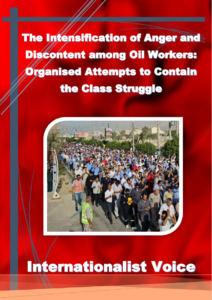
The Intensification of Anger and Discontent among Oil Workers: Organised Attempts to Contain the Class Struggle
The capitalism of metropole countries, at a time when the global capitalist crisis is deepening and the instability of the world economy is increasing, primarily seeks to transfer as many of the consequences of this crisis as possible to peripheral countries. However, the scale and intensity of global economic instability are far greater than what metropole capitalism can overcome through such manoeuvres alone.
As a result of the economic and military policies of the United States, as well as the significant rise in military spending in the metropole countries, the war economy is no longer a phenomenon confined to peripheral capitalism. Instead, it has become one of the central pillars of economic policy within the metropole countries themselves.
The expansion of the war economy has led not only the bourgeoisie of peripheral countries, but also that of the metropole ‒ including European bourgeoisies ‒ to intensify their attacks on social budgets, public services, and workers’ wages in order to finance the heavy costs of these policies. Although these attacks have even more destructive consequences in peripheral countries, they have also clearly lowered the living standards of the working class in the metropole and imposed increasing economic pressures on them.
Under such conditions, class struggle has always been the most important and effective means of resisting austerity measures and bourgeois attacks on workers’ lives and livelihoods. History shows that class struggle is not merely an abstract idea or slogan, but a real, tangible, and organised force that has, at various times, been able to challenge the structures of capitalism. From widespread strikes and collective protests to diverse forms of independent workers’ organisation, all have served as tools through which workers confront bourgeois attacks and austerity policies. Nevertheless, this struggle has always faced serious obstacles and challenges.
In recent years, workers’ protests and strikes across the world have followed an increasingly upward trend, a development that has been particularly noticeable in the metropole countries. In these countries, the bourgeoisie ‒ generally more far-sighted, experienced, and astute than its peripheral counterpart ‒ resorts less frequently to direct repression. Instead, it seeks to contain and channel workers’ struggles through its various institutions and instruments, including anti-worker trade unions and the left of capital. The aim of these policies is to confine protests to controlled forms, to dissipate workers’ anger and discontent, and to prevent the emergence of an independent, radical struggle rooted in the material conditions of class conflict.
Although significant protests are taking place in sectors such as healthcare and education, as well as among pensioners and other groups of workers, labour protests in industries such as oil, gas, and petrochemicals are of particular importance. These industries, first, have a greater capacity to exert pressure on capitalism due to their key role in the economy; second, they are characterised by an experienced proletariat whose historical memory includes significant and notable struggles; and third, they naturally elicit greater sensitivity on the part of the bourgeoisie to control and contain workers’ struggles.
For this reason, given the high potential of oil workers and the strategic importance of this industry for the bourgeoisie, the control and channelling of workers’ struggles is of particular importance to the ruling class. On this basis, the peripheral Islamic bourgeoisie, despite its short-sightedness, superficiality, and structural immaturity, also seeks to draw upon the experiences and models of the metropole bourgeoisie in order to contain and control workers’ struggles.
Within this framework, the present text, while referring to certain experiences and challenges faced by workers in different parts of the world, focuses primarily on the recent protests of workers in Iran’s oil industry. Its aim is to demonstrate how the Islamic bourgeoisie seeks ‒ by drawing upon experiences of controlling workers’ struggles in metropole capitalism ‒ to prevent the expansion, deepening, and development of workers’ struggles in the oil industry, initially not through direct repression, but through reliance on its own institutions and instruments.
Table of Contents
- Introduction
- A Brief Overview of Working-Class Struggles in the Oil Industry
- The Composition of the Workforce in the Oil Industry
- The Expansion of Workers’ Dissatisfaction
- Trade Unions: Instruments of Repression and Control of the Working-Class Struggle
- Trade Unions: Instruments of Capitalist Control over Working-Class Struggle
- Organisation in the wake of bloody repression
- Guild Associations and the Control of Workers’ Struggle in the Oil and Gas Industry
- Manoeuvres to Contain the Class Struggle
- Independent Proletarian Struggle: a Response to Capitalist Barbarism
- Basic Positions
Download the booklet as a PDF