The Persistence of Barbarism in Syria: Capitalism Means Barbarism
For years, Syria has been one of the main arenas of rivalry and the settling of scores between imperialist and regional powers. On the one hand, the United States and its Western and regional allies, including Turkey and some Arab states, and, on the other, Russia and the Islamic Republic of Iran, were each seeking to consolidate their position and influence in the country. But it was not the powers involved that paid the price of this rivalry. It was the Syrian people who paid the price of the war — and, first and foremost, the working class and the most deprived sections of society. The destruction of cities, the displacement of millions of people, mass killings and the collapse of social infrastructure were only some of the costs. The war turned Syrian society into an arena of naked violence.
At the time, some leftists and anarchists characterised the war in Syria as the “Syrian people’s revolution”. By concealing or downplaying the imperialist interests and contradictions involved in the war, they reduced the issue largely to a confrontation between the “people” and the “dictatorship”. Ultimately, this approach helped create the conditions for the oppressed masses to become foot soldiers for the projects of rival powers, effectively turning workers and working people into cannon fodder in imperialist tensions and rivalries.
Amid this imperialist barbarism, Turkey, in conjunction with the policies of the Western powers and within the framework of its regional and international interests, succeeded in strengthening its position in Syria, while, at the same time, the influence of the Islamic Republic of Iran was eliminated. With the fall of the Assad dictatorship and the accession to power of Ahmed al-Sharaa, known as Abu Mohammed al-Julani, the political and geopolitical balance of power in Syria changed; but, for the working class, the fundamental issue remained unchanged. The form of political power was transformed, but capitalist relations and the conditions of exploitation, poverty and capitalist brutality remained in place.
Al-Julani provides a clear illustration of this shift in political relations. In 2017, the United States offered a reward of up to $10 million for information leading to the identification or location of Abu Mohammad al-Julani, the leader of the al-Nusrah Front. Yet, just a few years later, the same figure who had been wanted in the context of the “war on terrorism” had become a negotiating partner and an official actor in the new Syrian order. The imperialists stripped him of his jihadist garb, baptised him anew, and rolled out the red carpet for him. In May 2025, Emmanuel Macron received him at the Élysée Palace as the interim president of the Syrian transitional authorities; and in November of the same year, Donald Trump met with him at the White House.
This shift cannot be explained simply by a change in the personality or the “moderation” of a criminal or jihadist. What has changed are the relations of power and the political and geopolitical needs of the imperialists. Someone who yesterday was officially described in Washington as a leader of a jihadist organisation can today be welcomed at the highest levels of Western diplomacy. This is not a sign of the end of terrorism, war or barbarism, but a telling example of imperialist politics in response to the needs of capital and the balance of power.
This change above all reveals one reality: in the foreign policy of capitalist states, “terrorist” and “political partner” are not fixed categories; the position of any political force is, to a large extent, determined by its relationship to interests and the balance of power.
An example of this logic can be found in the account given by Hamid Karzai, the former President of Afghanistan, of his conversations with US officials in 2013. In an interview on Tolo News’ Black and White programme, Karzai recounts that, during a discussion with American officials about the meaning of terrorism, he asked about the killing of Afghan women and children as a result of bombings. He goes on to relate their response as follows: terrorism becomes an issue when American interests are threatened. What matters to us here is not to establish a legal definition of terrorism, but to expose, through Karzai’s own account, the logic of imperialist power:
“If a bomb explodes in Kabul or in one of the provinces or villages of Afghanistan, and dozens of Afghan children and women are killed, is that terrorism or not? They said, ‘No, this is not terrorism.’ So I asked, ‘What is terrorism?’ They said, ‘Terrorism is when American interests are threatened.’”[1]
This logic should not be attributed solely to any particular party or president. The issue goes beyond Republicans or Democrats. In foreign policy, the state represents the interests of the ruling power and the social order of which it is itself a part.
The working class in the Middle East pays the cost of imperialist wars in various ways. In countries directly involved in war, this cost can be paid in lives lost, displacement, the destruction of workplaces and homes, and the destruction of the infrastructure necessary for social life. But even in countries where workers are not directly sent to the battlefield, war is not separate from their lives. Military spending, a war economy, inflation, austerity, cuts to public services, and the shifting of the costs of the crisis onto wage earners are other ways in which the cost of war is paid.
Capital is global, and the crisis of capital is global too. A war may take place thousands of kilometres away, but its costs can be transmitted into working-class life through energy prices, inflation, taxation, cuts to public services and a decline in purchasing power.
Following the fall of Assad’s dictatorship, alongside the political changes, another promise was put forward: economic improvement through Syria’s reintegration into the global economy. In 2025, US and European Union economic sanctions were largely lifted or suspended, and restrictions relating to banking, energy, transport and trade were eased. The stated aim of these measures was to support the political transition, revive the economy and rebuild Syria. In 2026, the removal of Syria from the US list of “State Sponsors of Terrorism” was also welcomed as a step towards further integrating Syria into the global financial system and attracting investment.
There was widespread propaganda: sanctions would be lifted, foreign capital would enter, banks would be reconnected to the global financial system, investment would increase, reconstruction would begin, and ultimately, people’s living conditions would improve. Yet the “reconstruction of Syria” could not even be achieved in the sense of rebuilding capital in Syria. And rebuilding capital does not mean rebuilding workers’ lives; the developments of recent months have highlighted precisely this contradiction.
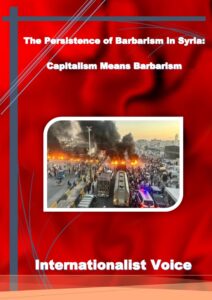
In September 2026, the Syrian government increased the price of diesel by around 40 per cent, while increases in the prices of petrol and gas were also announced. This decision sparked a fresh wave of protests, with demonstrations reported in various parts of Syria. Roads were blocked, tyres were burned, and the movement of oil tankers was disrupted.
The government has explained the price increases by citing higher import costs, Syria’s dependence on imported energy, developments in global markets, and problems at refineries. But for anyone whose livelihood depends on wages, these explanations change nothing. An increase in fuel prices does not simply mean more expensive energy. It means shifting part of the cost of the economic crisis onto the tables of those who are already living under the pressure of poverty. Therefore, the increase in fuel prices is the spark that ignites the protests, not their underlying cause.
The difference between the economic promises made after the fall of Assad and the reality of people’s lives can be seen in the prices of basic goods and services. The price of a subsidised bundle of bread rose from 500 old lira[2] before the fall of Assad to 4,000 old lira, meaning that its nominal price increased eightfold. At the same time, its weight was reduced. In May 2026, the weight of a bundle of bread was reduced from 1,200 to 1,050 grams, and in June the number of loaves in each bundle was reduced once again, while the price remained fixed at 4,000 old lira. The issue, therefore, is not simply rising prices. Even when the nominal price remains unchanged, reducing the quantity or weight of a product can constitute another form of price increase. The same logic applies to public services. The costs of energy, transport, housing and essential services have risen at a time when the incomes of a large proportion of the population have been unable to keep pace with these increases. Around 90 per cent of Syria’s population lives in extreme poverty.
From Aleppo, Idlib and Hama to Raqqa and Hasakah, protests have taken different forms. In some areas, protesters have blocked roads, while in the north-east, protests have also involved stopping oil tankers. These protests should not be understood merely as opposition to a decision to increase energy prices. When people can no longer afford the cost of living, they initially protest against the most immediate source of pressure.
From Aleppo, Idlib and Hama to Raqqa and Hasakah, protests have taken different forms. In some areas, protesters have blocked roads, while in the north-east, the protests have also involved stopping oil tankers. These protests should not be understood merely as opposition to a decision to increase energy prices. When people can no longer afford the cost of living, they initially protest against the nearest source of pressure.
Just as, during the Assad dictatorship, Western countries, Arab states and Turkey turned the protests in Syria into a tool for advancing their imperialist objectives and used the “Syrian Revolution” to further their own policies, today the opposing camp — al-Julani’s rivals, the Islamic Republic of Iran and forces close to it — is likewise attempting to exploit the protests in pursuit of its own imperialist interests and rivalries, and to promote them under the banner of the “Revolution of the Hungry”.[3]
These protests are, above all, a product of the crisis and brutality of capitalism. The recent protests may subside; the government may moderate some of the price increases, offer concessions or, conversely, intensify the scale of repression. But none of these measures will eliminate the fundamental contradictions of society. The crisis of livelihoods, poverty, unemployment, rising prices and economic insecurity are not the product of a temporary policy or a single government decision; their roots lie in capitalist relations and in the government’s efforts to shift the costs of the crisis onto the shoulders of the working class and the most deprived sections of society.
One of the weaknesses of “popular” and “all-together” protests is that, because they do not emerge from an independent class basis, they have the potential to come under the influence of bourgeois and reactionary tendencies. This problem can be seen clearly in other countries, for example in Iraq and Iran. Popular protests, however widespread they may be, can come under the influence of bourgeois, nationalist, religious, reactionary and imperialist forces when they are not formed and organised on the basis of an independent class position.
But the fundamental question for communists is whether the working class can advance its own independent class struggle and protests while maintaining its political and class independence; not whether workers merely participate as “citizens” and dissolve themselves into “all-together” protests. The issue is not the presence of workers in protests as part of the “people”; the issue is their independent presence as a class and their articulation of their own class demands and interests against capital and the state.
During the years of imperialist war in Syria, the brutality of capitalism had a naked and military face: bombing, killing, displacement, siege and destruction. Today, in conditions where war in its previous form is no longer taking place in many areas, the same social relations can impose another form of violence on everyday life: rising prices, poverty, falling real wages, unemployment and deprivation of the most basic necessities of life.
Alongside these economic pressures, one of the ever-present dangers in Syria is the fuelling and spread of sectarian and ethnic divisions. Under such conditions, people are defined first and foremost not as “workers”, but as Alawites, Sunnis, Kurds, Arabs, Christians, or members of an ethnic or religious group. This is precisely the fault line that bourgeois forces and rival states can exploit. When workers are divided along religious, ethnic or national lines, there is no longer any need to speak about their position within the relations of production, their relationship to capital, their wages or the conditions of their exploitation.
Years of war and capitalist brutality in Syria have left the country’s working class facing defeat, fragmentation and serious weakening. As a result, the formation of an independent proletarian response faces serious obstacles in the short term. This makes the importance of solidarity and class struggle by the proletariat of other countries all the greater. The question facing the Syrian working class cannot be resolved separately from the struggle of the working class in the region and around the world.
The proletariat must not become an instrument for the reconstruction of capital; it must not serve as cannon fodder for states and armies; it must not become the labour force for “national reconstruction” projects; nor must it be turned into the infantry of sectarian groups and bourgeois movements. For the working class to be able to stand against capital, it must maintain its independence from all factions of the bourgeoisie. Capitalism is a global system, and the struggle against it cannot be confined within national borders.
Capitalism is reproduced everywhere, in different forms, through wage labour, exploitation, poverty, war and social repression. The barbarism of capitalism does not appear only on the battlefield; it is also present in the factory, in the workplace, in rent, in queues for bread and fuel, and wherever the costs of the crisis are shifted onto the shoulders of the working class. War is only one form in which this barbarism manifests itself; the same relations that lead to killing and destruction on the battlefield also result in poverty, deprivation and the continual erosion of workers’ living conditions in everyday life.
From this perspective, the real end to the barbarism of capitalism cannot be achieved through a change of government, the lifting of sanctions, “national reconstruction”, or the transfer of power between different factions of the bourgeoisie. At best, such changes can alter the form and organisation of capital’s domination without abolishing capitalist relations themselves. The only way to break this cycle is through the fundamental overthrow of capitalist relations, enabling the working class, through communist revolution, to open the way to ending wage labour, exploitation and the division of society into classes; towards a society free from the exploitation of human beings by human beings, wage slavery, classes and the class state.
Therefore, the issue facing Syria today is not a choice between this or that government, this or that faction of the bourgeoisie, or this or that imperialist camp. The issue is the formation of an independent proletarian force against all of them. The working class cannot rely on any of the forces of capital for its liberation, because each of these forces, regardless of their political and ideological differences, has a vested interest in preserving and reproducing capitalist relations.
The future of humanity cannot be entrusted to the competition between states, capitalists and imperialist powers. Only the conscious, independent and organised struggle of the working class can make it possible to break with the cycle of war, poverty and capitalist barbarism.
Capitalism means barbarism; and as long as the relations of capital remain in place, barbarism does not merely change its form — it becomes more widespread, deeper and more horrific.
M.J.
17 September 2026
Notes:
[1] In his account of his conversations with US officials on Tolo News’ Black and White programme, Hamid Karzai makes this point. For the video, see approximately the 40-minute mark of the interview: Tolo News interview with Hamid Karzai.
[2] From 1 January 2026, the new lira was introduced into circulation by the new regime. Two zeros were removed from the old lira; in other words, one new lira was equivalent to 100 old lira. Both currencies also remained legal tender simultaneously for a period.
[3] Examples include the following:
Download as PDF