Execution, an Instrument of Bourgeois Repression; Class Struggle, the Path to Emancipation!
“What a state of society is that which knows of no better instrument for its own defence than the hangman, and which proclaims through the ‘leading journal of the world’ its own brutality as eternal law?” — Marx (Capital Punishment)
The criminal Islamist bourgeoisie has unleashed a new wave of executions in recent days and weeks. These executions include both ordinary prisoners and prisoners who have been arrested in connection with the protests or sentenced to death on charges such as espionage. Execution is one of the most naked forms of state coercion and repression, and it must be understood within the framework of capitalist class relations and the role of the state as an instrument of class domination.
The shameful history of the Islamist bourgeoisie is a history steeped in repression and bloodshed. In the 1980s, the Islamist criminals imprisoned tens of thousands of people who opposed the dictatorship and the prevailing brutality, and executed and massacred tens of thousands of political prisoners. Executions, mass killings and repression have not been exceptional events, but an ongoing part of the conduct of the Islamist bourgeoisie throughout its shameful existence.
From a Marxist perspective, opposition to the death penalty is not merely a moral or human-rights position. The fundamental issue is a social and class critique of punishment and of a state that claims the right to take human lives. In his writings on capital punishment, Marx also challenged the notion that society can solve a social problem by killing a human being. Opposition to the existing order, and even offences, crimes and punishment, cannot be separated from the social conditions and relations that produce them.
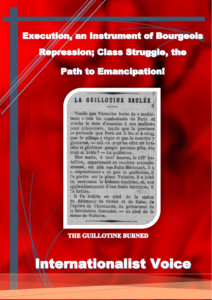
The experience of the Paris Commune is also significant from this perspective. On 6 April 1871, a group of National Guards and Parisians took the guillotine to the Place Voltaire, broke it up in front of the crowd, and set it on fire. This symbolic act expressed hatred and protest against one of the most naked instruments of state coercion. The burning of the guillotine, in the context of the Communards’ struggle against the existing state apparatus, symbolised a break with the tradition of state punishment and repression.
Following the October Revolution, the Soviet power abolished the death penalty in the first months of the revolution. The trial of the Romanov family was intended to become an indictment of the world bourgeoisie. It was only with the onset of military intervention by the imperialist powers and the intensification of the civil war that the death penalty was reinstated, under conditions in which the revolution was being defended against the counter-revolution.
Repression, executions and massacres must be understood in relation to the capitalist system and the class state. In Iran, these capitalist relations are intertwined with an Islamic ideological and political superstructure. Therefore, putting an end to the brutality of the Islamic bourgeoisie’s machinery of repression cannot be achieved merely by changing the form of government or reforming penal laws; it requires the dismantling of the social relations that reproduce domination, exploitation and state repression.
By contrast, the crocodile tears shed by bourgeois democracies, particularly European governments, over executions and violations of ‘human rights’ in Iran should not deceive us. Western governments’ opposition to executions, their imposition of human-rights sanctions, and their political support for certain protests all form part of the framework of bourgeois states’ interests and rivalries, as well as their policy of exerting pressure on the Islamic Republic. These governments are themselves part of the global capitalist system and its machinery of state repression, and cannot offer an alternative for the emancipation of the proletariat.
Relying on international bourgeois institutions and bourgeois governments, all of which are war criminals, to put an end to repression can only foster false illusions about bourgeois democracy. The fundamental issue is for the working class to recognise its historical power as a class and to enter into class struggle against the state and capital, independently of all factions of the bourgeoisie.
Only the independent class struggle of the proletariat can challenge the repressive machinery of the Islamic bourgeoisie while, at the same time, preventing counter-revolutionary forces, different factions of the bourgeoisie, and reactionary groups from turning social discontent to their own ends. What emboldens the repressive apparatus of the Islamic bourgeoisie is not merely its apparent power and authority; more importantly, it is the absence of the proletariat from the arena of struggle as an independent and organised class force.
Capitalism smells of blood, filth, executions, massacres, war and barbarism. The fundamental issue for the working class is not to reform certain laws or replace one form of bourgeois government with another, but to overthrow capitalist social relations through communist revolution. More than ever, the future of humanity depends on the historic struggle of the working class.
To put an end to executions, capitalism must be overthrown!
F.A.
24 Agust 2026
Download as PDF