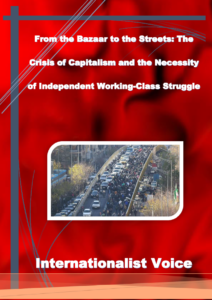
From the Bazaar to the Streets: The Crisis of Capitalism and the Necessity of Independent Working-Class Struggle
A new wave of protests in Iran began on 28 December 2025, following a sharp decline in the value of the national currency against foreign currencies. The significant depreciation of the national currency, combined with rising foreign exchange rates, led many bazaar traders to refrain from conducting transactions. Subsequently, traders at the Aladdin Mobile Bazaar, the Charsou Complex, Shoush Bazaar, the Grand Bazaar of Tehran, and other bazaars staged protests by closing their shops. The traders also held a protest gathering on Jomhouri Street in Tehran to express their dissatisfaction. Their main demands were exchange-rate stability, curbing inflation, and greater stability in economic activity.[1]
The protests by bazaar traders carried a clear message for the ruling authorities, as the bazaar has long been regarded as part of the establishment and one of its key socio-economic pillars. Its interests are fundamentally tied to economic stability, the control of exchange-rate fluctuations, and the continuation of the cycle of capital accumulation. The discontent of this sector highlights the depth of the economic crisis and the authorities’ inability to provide even a minimal level of stability, including for social groups that have traditionally been aligned with them.
The bazaar and its traders have also played a role in contemporary political developments in Iran. During the protests and strikes of 1978–79, bazaar traders helped weaken the Shah’s regime and facilitate the transfer of power by closing markets and financially supporting the forces that later established the rule of the Islamic bourgeoisie. Part of the capital and financial resources necessary for the formation and consolidation of the government that came to power after 1979 was provided through this channel. For this reason, today’s protests by bazaar traders cannot be seen merely as a temporary reaction to economic fluctuations; rather, they should be regarded as a sign of deepening divisions within the economic and political relations of the ruling class.
In response to the voice of the bazaar, for the first time, the Islamic bourgeoisie’s state television deliberately covered the protests of bazaar traders. To prevent individuals’ identities from being fully discernible, this coverage was accompanied by somewhat blurred and unclear images.
Subsequently, a state television reporter was dispatched to the bazaar to cover what he described as the traders’ “legitimate economic demands.” This form of media coverage not only highlighted the significance of the bazaar within the power structure but also illustrated how the official media seeks to present the protests of a sector traditionally aligned with the authorities in a controlled and harmless manner.
To contain the protests, the President held a meeting with the heads of the bazaar to discuss their problems and demands. The Islamic bourgeoisie also replaced the head of the Central Bank. In addition, the bourgeois government and parliament made four key decisions for the trade sector:
- Suspension of the implementation of tax system requirements for traders for one year
- Suspension of the application of value-added tax for traders
- Suspension of tax penalties for traders and bazaaris
- Halting new requirements in the National Licensing Portal for traders and bazaaris[2]
Initially, the Islamic bourgeoisie sought to prevent the protests from spreading by appearing tolerant, portraying the bazaar traders’ grievances as “legitimate,” and emphasising the need for dialogue with the demonstrators, even showing a degree of restraint for a time. However, these assurances did not stop the protests from spilling beyond the bazaar, quickly spreading to other cities and universities and taking the form of street demonstrations. As the protests expanded, repression began.
Street protests are a product of capitalist crises, but the impact of these crises is more severe in peripheral capitalist countries than in the metropolitan centres of capitalism. Consequently, street protests present a greater challenge for governments in peripheral capitalist states. A defining feature of these protests is their popular, street-based nature, in which lower- and middle-class groups—regardless of ideological orientation or class affiliation—and even reactionary, far-right forces participate and can influence their course.
During the crackdown, the disgraceful Islamic bourgeoisie has, as of the time of writing, killed at least ten protesters and two Basij[3] members, while a large number of people on both sides—protesters and security forces, including the Basij—have been injured. The majority of the fatalities are from the provinces of Lorestan and Chaharmahal and Bakhtiari, and the main concentration of the protests has also been in provinces such as Lorestan, Chaharmahal and Bakhtiari, Hamedan, Ilam, and Kermanshah. In other words, the protests have primarily occurred in the western and south-western regions of the country, while in major cities such as Tehran, Tabriz, Mashhad, Shiraz, and Ahvaz, they have remained marginal.
Hamedan was one of the cities where the protests were more intense than in other areas. In response, the Islamic bourgeoisie organised a government-backed march with its supporters to demonstrate that it still held influence. This approach has also been applied in universities; for example, at Imam Sadiq University, a call was issued to hold a similar gathering.
Before continuing with the analysis of events, it is helpful to compare recent street protests in order to examine their trends, characteristics, and differences more precisely, and to establish a clear framework for analysing the current situation.
The December 2017 protests began in response to soaring prices and rampant inflation, with the initial participants including those who had lost money in financial and credit institutions and were protesting widespread corruption. These protests spread to other cities, involving fragmented workers—particularly the unemployed—and other social groups. For this reason, the protesters’ demands were diverse, and the movement was a popular, “all-together” uprising.[4]
Following the increase in petrol prices, which not only placed additional pressure on the already strained households of the working class but also affected all lower sections of society, a new wave of street protests swept across the country from 15 November 2019. The driving force behind these protests was not the organised working class, but, as in the December 2017 protests, fragmented workers, the unemployed, and other lower strata of society, who, in response to the capitalist crisis, protested in the form of an “all-together” movement.
The response of the Islamic bourgeoisie was a widespread and ruthless crackdown by the police state. Although this movement had an “all-together” character, it was among the most radical popular protests of the period and was less exploited by reactionary and far-right forces than similar movements in previous periods; for this reason, it was suppressed with even greater intensity.[5]
In September 2022, the killing of Mahsa Amini by the police sparked a new wave of street protests. The driving force behind these protests was primarily young people who saw no future for themselves under a crisis-ridden peripheral capitalism. However, due to the nature of their demands, this protest movement took on a democratic character and did not exhibit the apparent radicalism of the 2017 and 2019 protests. This democratic orientation also led the movement to become, on a global level, a tool for exerting pressure on the disgraceful Islamic bourgeoisie amid imperialist tensions.[6]
The current popular protests, due to the demands from which they originated and the changes they have undergone, do not even reach the level of the “all-together” protests of 2022 and are comparatively more limited. For this reason, ultra-reactionary forces, monarchists, and opportunists are able to find space to assert themselves within these protests.
Leftists and the Mujahedin claim that monarchists are attempting to influence the protests in favour of “Reza Pahlavi”[7] by adding audio to video clips, or that this role is being played by the Islamic bourgeoisie itself, which is confident in the harmlessness of the monarchist opposition. In other words, they argue that the promotion of monarchist demands within the protests is either meaningless or marginal. This claim is partly correct, but it does not capture the full reality.
First and foremost, it should be emphasised that the nature of a movement determines the extent to which it can be exploited or redirected. In an independent workers’ movement, this possibility is considerably low; however, in an “all-together” movement, the scope for reactionary forces to intervene is much greater. Within this framework, a serious question arises: can the statement issued by students at Isfahan University, in which it was asserted that “the 1979 revolution was a historical mistake,” be regarded merely as the result of external manipulation and interference?
For leftists who, through demagoguery, consider students to be “working-class students,” it is as if students necessarily advance the demands of the working class in every protest. In reality, however, students are not inherently revolutionary; at times, they can play a counter-revolutionary role, and at other times, depending on objective conditions and their connection to the class struggle, they can assume a revolutionary role. To clarify this issue, two specific examples can be cited.
The student protests of July 1999 arose in response to the closure of the reformist[8] newspaper Salam. These protests served the interests of the reformist faction of the Islamic bourgeoisie, and students became instruments in intra-governmental struggles. Nevertheless, the movement exacted a heavy toll, leaving many dead and injured, and profoundly altered the fate of some of the students.
In contrast, in autumn 2018, following the widespread workers’ protests, students openly expressed solidarity with the workers’ struggles and placed class demands at the centre of their slogans. By chanting slogans such as “We are the children of workers; we stand with them,” they effectively became integrated into a segment of the workers’ class movement and played a role distinct from that of previous periods.
The notion that the bloodier a protest is, the more radical it must be, is mistaken and bears no relation to the fighting tradition of the working class. Such a perspective equates radicalism with the intensity of repression and the level of violence, whereas, from the standpoint of the class struggle, radicalism is connected to a movement’s level of consciousness, organisation, and anti-capitalist orientation. This mistaken view, rather than being rooted in the Marxist tradition, is closer to the anarchist tradition—a current that does not believe in the collective, conscious, and organised power of the working class and substitutes social explosions for class struggle.
From a class perspective and a communist standpoint, the workers’ protests of autumn 2018, which did not result in a single death, were far more radical and anti-capitalist than the November 2019 protests, which left around 1,500 dead. The measure of radicalism is not the number of victims, but the level of conscious participation, social connection, and the potential for independent advancement of the working class.
The violence of the proletariat, unlike that of the ruling class, is collective and grounded in proletarian class consciousness. Proletarian uprisings, proletarian revolutions, and the breaking of bourgeois resistance are inseparable components of the collective, class-based violence of the working class. This violence is not the result of individual actions, but the outcome of collective decisions by the proletariat, directed towards its historical and long-term objectives. For this reason, the collective, class-based violence of the proletariat bears no relation to individual, personal violence or to actions concealed under any guise of radical rhetoric.[9]
During the workers’ protests of autumn 2018, the streets became spaces for the presence of families and local residents, and the boundaries between the factory, the neighbourhood, and public spaces were largely blurred. Streets, neighbourhoods, and workplaces became arenas for discussion, dialogue, and even political debate. The streets had effectively turned into public assemblies. This situation fostered a form of collective consciousness that enabled the protesters to continue their struggle not reactively or explosively, but consciously and persistently. It was this process that, over time, led the protests to become more radical.
Social protests and street mobilisations can play a leading role only when they serve the workers’ class movement. The streets must become spaces for family gatherings, the formation of public assemblies, and the connection between different sections of society. Only under such conditions can protests move beyond mere dissatisfaction or anti-regime and pro-democracy demonstrations to become an anti-capitalist struggle—a struggle that can lay the groundwork for the formation of factory committees, strikes, local organisations, and other forms of independent, class-based organisation.
When the working class emerges as an independent social class in the course of societal developments, the scope for manoeuvre of not only the right- and left-wing tendencies of capital but also ultra-reactionary bourgeois forces and adventurist elements is sharply reduced. This is because the independent presence of the proletariat exposes the real contradictions of capitalism and prevents protests from being redefined and co-opted within bourgeois, pro-democracy, or imperialist frameworks.
A clear example of this situation can be seen in the workers’ protests of autumn 2018, a period during which media outlets such as the BBC, Voice of America, Radio Israel, and other bourgeois propaganda instruments were effectively sidelined and lost the ability to influence the protests. Under such conditions, bourgeois tendencies—particularly the hypocritical and liberal tendencies of the Western bourgeoisie—were compelled to be silenced, as the language, perspective, and demands of these protests could not serve their class interests.
Leftists describe these protests as a “struggle of workers against capital” and, by chanting slogans such as “Forward to revolution,” seek to rally the working class to join them and, through a nationwide political general strike, overthrow the regime. Put more plainly, under this plan, the working class is expected to set aside its independent struggle and become cannon fodder for pro-democracy and anti-dictatorship movements.
This approach is not a new phenomenon. In 1978–79, the left of capital also played a role—not out of ignorance, but as the logical outcome of its class position and character—contributing to the consolidation of the Islamic bourgeoisie while praising the “anti-imperialist” understanding of the Imam. At the same time, communist left, relying on their affiliation with the proletarian camp and guided by an internationalist perspective, analysed the conditions and resisted the myth-making around the clergy.
In response to the absurdities of the left of capital, which turned a reactionary figure like Khomeini into a “defender of the oppressed” and portrayed the clergy as “anti-imperialist,” internationalists declared in February 1979 that Khomeini was no more progressive than the Queen of England or Emperor Bokassa[10]. They clearly stated that the proletariat must maintain its class independence and must not be subsumed into popular or cross-class movements.
Workers in Chains!
Our interests do not lie merely in replacing one ruling class with another. The experience of 1978–79 clearly showed how the Islamic bourgeoisie rode on the back of our struggles and, as a result, ousted the royalist bourgeoisie without ending wage slavery for our class. What continued were exploitation, unemployment, and, ultimately, the bloodbath that the disgraceful Islamic bourgeoisie imposed on society.
For this reason, our slogans and the horizon of our struggle should be directed not at changing the form of the ruling power, but against wage slavery, exploitation, unemployment, and the capitalist system as a whole. More precisely, it is the capitalist system itself that must be targeted. Most importantly, the workers must take the destiny of the struggle into their own hands. When workers exercise direct leadership of the struggle, the movement becomes stronger, broader, and more effective.
This path requires a form of organisation based on collective, transparent, and bottom-up decision-making. Public assemblies, strike committees, and elected bodies of the struggle can serve as effective tools for coordinating protests, expanding the movement, and preventing interference or the co-optation of the struggle. Only through such structures can scattered protests develop into a coordinated, conscious, and powerful movement.
The real power of the working class lies in its unity and collective consciousness. Capitalism is the source of all disorder and misery throughout the world, and our class interests demand that the destruction of the system as a whole be made the objective of the struggle. By virtue of its anti-capitalist nature, class struggle, in the course of its development, will not only spread to other capitalist countries but will also directly challenge the capitalist state itself. For this reason, we must fight solely and exclusively for our own class interests.
Long live the war between the classes!
The Future Belongs to the Class Struggle!
Long Live the Independent Workers’ Struggle!
Internationalist Voice
3 January 2026
Notes:
[1]Petty-bourgeois protests, including those by bazaar traders, lorry drivers, and farmers, not only fail to clarify the path of the workers’ struggle but can also lead it astray. Workers who align themselves with these movements come under the influence of petty-bourgeois ideology and drift away from the course of the class struggle. As a result, rather than strengthening the workers’ struggle, it is weakened. For a more in-depth understanding of this issue, reading the following two articles is recommended:
- From Road to Class: Transport Strikes and the Necessity of Working-Class Independence
- Anger of the farmers: a cry of despair instrumentalised against workers’ consciousness
[2]Facilitating market activity and easing economic pressures through an agreement between the government and parliament.
[3]Basijis (Basij members) are volunteers in a paramilitary organisation in Iran, officially known as the Basij Resistance Force, which operates under the Islamic Revolutionary Guard Corps (IRGC). They are often mobilised to enforce government authority, maintain internal security, and suppress protests or civil unrest.
[4] For further information and analysis of these protests, please refer to the article “Street protests amid the barbarity of capitalism -The only alternative is class struggle.”
[5] For further information and analysis of these protests, please refer to the article “Street protests amid the barbarity of capitalism -The only alternative is class struggle”.
[6] Several publications have been released on this subject, including the following:
- A New Wave of Street Protests: The Proletarian Horizon and Perspective
- The continuation of the protests, the alternativization of capital and the perspective of the working class
- The Charter of Minimum Demands or the Charter of Curbing the Class Struggle
[7] Reza Pahlavi, the son of Iran’s last Shah, Mohammad Reza Pahlavi, is being promoted by Western countries and Israel as an alternative to the Islamic bourgeoisie.
[8]The use of the term “reformist” is solely due to the label adopted by this bourgeois faction itself; otherwise, this same faction has played a significant role in repression. Setting this aside, in the era of capitalist decay, reformism and reforms have lost their meaning, as it is no longer possible to impose sustainable reforms on the bourgeoisie.
[9] Class-based violence or adventurism is clearly examined in the book “The Anti-Capitalist Workers, A Manifestation of the Non-Horizon of Councilism”, with reference to historical events.
[10] February 1979: when internationalists announced that Khomeini was no more progressive than the Queen of England or Emperor Bokassa I.
Download as PDF