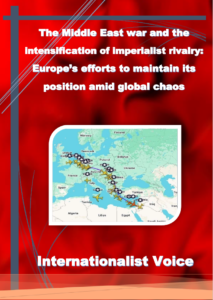
The Middle East war and the intensification of imperialist rivalry: Europe’s efforts to maintain its position amid global chaos
Introduction
With the outbreak of war in the Middle East, the United States was unable to draw Europe, as it had in the past, fully behind it in the escalation of the war, particularly Britain, which has traditionally been one of the closest followers of American foreign policy. During the twelve-day US–Israeli war against Iran in 2025, the European bourgeoisie, although not directly participating in the military attacks, nevertheless emerged at the economic, political and diplomatic levels as a belligerent force, defending the logic of imperialist war.
In examining the current war, if we set aside abstract statements and diplomatic posturing and instead take the actual conduct of the European bourgeoisie as our basis, three distinct positions can be identified.
First, the warmongering position adopted before the outbreak of the war in the Middle East, when the principal sections of the European bourgeoisie, through military, economic, political and diplomatic pressure, as well as by supporting and strengthening the pro-Western opposition, fuelled tensions in alignment with the policies of the United States and Israel and reinforced the conditions for military confrontation.
Second, from the middle of the war onwards, a kind of intermediate position emerged which was neither explicitly belligerent nor representative of bourgeois pacifism; rather, it was an attempt to manage the position of the European bourgeoisie under the new conditions and to preserve the independent interests of European capital.
Third, during the period of the temporary ceasefire, the European bourgeoisie presented itself in the guise of bourgeois pacifism, not from a position of opposition to war, but in order to reconstruct the balance of forces within Europe amid the new global disorder and to consolidate its position within the imperialist order currently being reshaped.
Extensive propaganda is being circulated claiming that American warmongers are displeased with the European bourgeoisie’s reluctance to enter the Middle Eastern war in an aggressive manner, and that they have openly expressed this dissatisfaction. Trump reportedly complained about France for not allowing a weapons-carrying aircraft to pass through its airspace en route to Israel, stating that “the United States will not forget this”.
Spain has also announced that it will close its airspace to aircraft involved in the war against Iran. There are also reports that Italy has refused landing permission at the Sigonella base in Sicily to a US military aircraft bound for the Middle East; a base which, although belonging to the Italian Air Force, also hosts a US Navy presence.
Does this mean that the European bourgeoisie has become pacifist and opposed to war? From a Marxist perspective, and dialectically within the era of imperialism, is it possible for the bourgeoisie to become pacifist?
Despite the differences that have emerged between Europe and the United States in recent years, the European bourgeoisie has, on the whole, although it did not directly join the American war effort, continued to provide general support for the Middle Eastern war and for US–Israeli strikes, particularly at the political, diplomatic, and defence levels. In most cases‒though not in all‒it has continued to follow US policy.
In reality, the disagreement between the United States and Europe is not over the principle of war itself; Europe is already engaged, through the war in Ukraine, in a de facto imperialist confrontation with Russia. The issue concerns the methods, timing, and respective shares of each power in the redistribution of influence, spheres of dominance, and interests. The United States demands unconditional alignment from its allies in advancing the war and consolidating its hegemony, whereas the European bourgeoisie seeks to preserve its position within the emerging global order‒or, more accurately, within the chaos of the present world situation and the shifting balance of imperialist forces.
Table of Contents
- Introduction
- The bourgeoisie against the working class, regardless of its political rhetoric
- The decline of Europe’s position
- United Kingdom and the Middle Eastern War
- France and the Middle East War
- Germany and the Middle East War
- Spain and the Middle East War
- Civilised Barbarians in the Guise of Pirates
- Russia–China and the War in the Middle East
- European Economic, Political, and Intelligence Support for the United States and Israel
- The proletariat is a class, not a nation
- Basic Positions:
Download the booklet as a PDF