Capital’s Imperialist War: Massacre of the Working Class Across Work and Life Spaces
In every imperialist war, regardless of the eloquence and rhetoric of the ruling criminals, it is the working class and the oppressed who are turned into cannon fodder. With every missile fired, every drone that flies over the cities, and every explosion that reduces a factory, port, refinery, school, or hospital to rubble, it is the workers who are the victims. Their workplaces and living spaces are transformed into battlefields, and the fruits of years of labor and production are destroyed in an instant. Beneath the rubble of factories, ports, mines, and working-class neighborhoods lie not only human lives but also the product of years of toil and suffering of the working class.
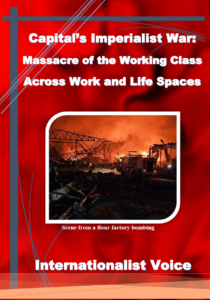
On the night of March 7, 2026, the “Payard” starch and flour factory in the city of Naqadeh was targeted in an airstrike while night-shift workers were on duty. Following the bombing, several wage slaves—the breadwinners of working-class families—were killed, and many others were injured. The explosions were so intense that it was as if flames had erupted from a blazing refinery. In an instant, these workers’ workplace was transformed into a scene of death and destruction. Their names are deliberately withheld so that they are remembered not merely as victims of a local incident, but as symbols of the massacre of workers in this imperialist war, extending beyond national borders.
The bombing of a flour factory in a remote, marginal town—a town with neither significant military facilities nor any strategic importance—clearly shows that the war criminals, contrary to the lies and deceptions claiming they only target military objectives, in practice carry out indiscriminate, widespread bombings.
At every moment, the working class in some corner of the Middle East becomes a victim of this dirty, imperialist war. The machinery of capital, through its war-hungry criminals, imposes this slaughter on the workers, and unfortunately, these massacres continue to expand day by day.
This example reveals only a small part of the scale and scope of the bombings. While such attacks occur in various cities across the Middle East, the main focus remains on Tehran in Iran and Beirut in Lebanon. Tehran is currently experiencing one of the heaviest and most terrifying carpet bombings. In Iran, based on available data, approximately 40 percent of attacks have been concentrated in Tehran Province, followed by Isfahan Province at 9.6 percent.
In the Gulf countries, the economy is largely based on oil and gas, ports and maritime transport, construction, and urban services. The operation of these vital economic sectors depends heavily on migrant labor. A large portion of the workers employed in refineries, ports, construction projects, urban services, and transportation come from countries such as India, Pakistan, Bangladesh, Nepal, the Philippines, and several Arab states—workers who are often employed under harsh conditions, with low wages and limited rights.
As a result, the primary and most immediate victims of these attacks are the workers, because when infrastructure is targeted, their workplaces and living spaces are directly attacked, and their daily security and livelihoods are destroyed. Among these victims are a large number of migrant workers—workers who even come from countries not directly involved in the war, such as India, Pakistan, Bangladesh, Nepal, and the Philippines. They labor under harsh conditions and low wages in refineries, ports, construction sites, and urban services, and any attack on infrastructure directly threatens their lives and security. These are the workers who face the immediate consequences of bombings, explosions, and destruction, paying the true price of war with their lives.
The bourgeoisie seeks to divide the working class in order to break their class unity and exploit them more easily and effectively. To achieve this goal, it constructs false national and religious identities to keep workers blind to their class identity. But the reality is that workers in the Middle East, Europe, Asia, Africa, and the Americas are all bound together by a shared fate, and their defining common feature is belonging to the exploited class—the working class.
We should not rejoice at the deaths or the destruction of workers’ homes across the border. On the contrary, we must express our class solidarity. Our enemy is not the workers on the other side of the border; our enemy is the war-hungry rulers—whether in Tehran, Tel Aviv, Washington, Riyadh, Berlin, Paris, London, or any other capital where the state of capital is entrenched and turns us into cannon fodder in the imperialist war.
Even in places where workers are not directly turned into cannon fodder in the imperialist war, they still pay the price through austerity policies, a war-driven economy, and the shrinking of their livelihoods. This demonstrates that the barbaric capitalist system continues economic exploitation and pressure everywhere, not just on the battlefield.
Class solidarity among workers is a true and fundamental solidarity because it is rooted in the shared conditions of life of all wage slaves. We must stand in solidarity with our chain-bound comrades—our sisters and brothers in the working class—beyond national borders, and direct our class hatred and revenge against the ruling class through class struggle.
Although the working class in the Middle East is currently enduring extremely harsh conditions—on the one hand due to terrifying bombings, and on the other due to war policies and repression—taking up the struggle at a global level represents the real response to imperialist war and an example of true class solidarity.
When workers turn the imperialist war into a war against capitalism, this struggle, in its continuity, can challenge the state of capital, place the global proletarian revolution on the agenda, and create a world without borders, without war, and without exploitation for humanity.
Down With the Imperialist War!
Long Live Workers’ Class Solidarity!
Long Live the War Between the Classes!
Joseph
March 13, 2026
Download as PDF