Response to Imperialist War: Inter-classist Pacifism or Class Struggle?
Imperialist war, this monster created by capital, reveals its true face and barbarity more clearly with every passing day: the bombing of cities, the destruction of homes, and the slaughter of workers and the oppressed who play no role whatsoever in the decisions of the warmongers. Beneath the rubble of factories and hospitals, in the streets, in workplaces, in markets and in homes, the lives of human beings are extinguished—people whose only “crime” is to live in a world that capitalism has turned into a field of slaughter and bloodshed. With every bombing and every missile strike, it is not only walls that collapse and human beings who are massacred; countless dreams, hopes, and lives collapse with them as well.
Imperialist war does not only destroy cities; it does not only devastate the infrastructure of society or lead to the killing of human beings; it also wounds the human conscience. In the face of such barbarity, the conscience of many people cannot remain at ease; hearts ache, and anger and sorrow become intertwined. Within them arises a feeling of anger, grief and shame: anger at such barbarity, grief for the lives that have been so easily destroyed, and shame at a world that makes such crimes possible. They do not wish to remain indifferent, and hatred of war and of the warmongers begins to blaze in their hearts. The essential question is this: how can imperialist war be confronted? How can this organised slaughter be brought to an end?
In the horrific conditions of war in the Middle East, the conscience of a Member of the British Parliament was stirred by the massacres of this imperialist war. In the chamber of the British Parliament, she addressed the Prime Minister over the government’s support for the war and asked:
“How Much Do You Enjoy Being Donald Trump’s Poodle?”[1]
Should we not feel some satisfaction that one of the war criminals—the Prime Minister of Britain—was humiliated, and that too in the chamber of the British Parliament? Do such events not help to relieve the pent-up anger of so many people? Should we not also commend Paul Magnette, the Member of the Belgian Parliament? In the parliamentary chamber, by using the term “war criminal,” he emphasised the necessity of taking an independent stance in the face of US pressures and challenged its warmongering policies in the Middle East. Within this context, he said the following:
“Not one of our soldiers, not one of our weapons, should go for Trump’s war in Iran. We must do like Pedro Sánchez and say no to Trump. Trump has chosen Netanyahu as his ally, a war criminal responsible for the genocide in Gaza. Trump has decided to use brute force in violation of all the principles of international law.”[2]
The reality is that the anti-war statements of some parliamentarians, far from reflecting any class-based will or ability to bring the war to an end—which is fundamentally impossible given their belonging to the bourgeoisie—are instead a reflection of tensions and divisions within the various factions of the ruling class. None of the bourgeois factions is capable of offering a horizon for genuine peace, because capitalism itself, regardless of the rhetoric of its different factions, is the source of this war. More importantly, such statements often foster illusions about the ruling class and the institutions of bourgeois democracy, obscuring the undeniable truth that it is the bourgeoisie itself that is responsible for this war, and reducing the issue of war to little more than competition among rival politicians.
Bourgeois democracy plays a central role in preparing and advancing imperialist wars, because it enables the ostensibly democratic institutions of society to be used to organise and legitimise war. This system, relying on its extensive media and political resources, is capable of shaping public opinion to secure acceptance of, and support for, war. Within this framework, bourgeois democracy presents war as the expression of a government’s will, supposedly freely chosen by the people, thereby creating the illusion that war is undertaken in defence of the very people who have elected that government.
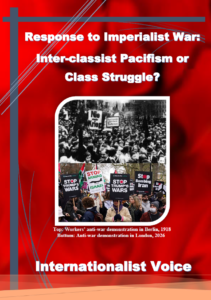
If we put aside bourgeois parliamentarians, we arrive at the anti-war movements that, in recent decades, have been shaped around “all-together” slogans and demands. These movements typically seek to bring together a broad spectrum of social and political forces, regardless of class or political differences, within a common framework.[3] A clear example of this approach can be seen in the widespread protests against the Iraq War in 2003. In recent years, alongside protests against the genocide in Gaza, the same pattern has reappeared, taking the form of weekly demonstrations in many cities. Now, with the escalation of military tensions in the Middle East, this same protest framework has been applied to anti-imperialist war demonstrations in the region and has become one of the common forms of organising anti-war protests.
However, the reality is that such demonstrations, by themselves, cannot offer any horizon for ending imperialist wars. The main reason for this lies in the very basis and “all-together” demands of these protests—a basis which, due to the absence of clear class boundaries, often allows very different, and even contradictory, forces and tendencies to come together. Under such conditions, these protests can easily fall within the framework of the competition and interests of different bourgeois factions and become a tool for advancing their objectives.
For example, during the widespread protests against the Iraq War in 2003, the Democratic Party of the United States, as part of the bourgeoisie in opposition, sought to exploit these protests to exert political pressure on the rival faction—the Republicans in power.
In recent protests, the flags of various nationalist or reactionary forces have also been visible among the demonstrators. Not only the flag of Iran’s Islamic bourgeoisie, but no other national flag, not even the most democratic, is worth shedding a single drop of workers’ blood for.
For the communist left, which has always been at the forefront of opposition to imperialist wars, being anti-war is neither an abstract nor merely moral. This stance is grounded in a historical and dialectical analysis of the development and transformation of capitalism. From this perspective, imperialist war is not the result of the decisions of warmongering or ignorant individual politicians, but rather the product of capitalism itself. For this reason, the struggle against war cannot be separated from the class struggle against this system; it is only in connection with the working class’s fight against capitalism that a real prospect for ending war can be opened.
On this basis, “all-together” peace movements, even if they succeed in taking to the streets, are incapable of offering a genuine horizon for ending imperialist wars. There is no doubt that the streets must be transformed into spaces of presence and protest against war, and into public forums for anti-war demonstrations. But this can only acquire a liberatory meaning if it is organised as part of the class struggle of workers, grounded in their class position. Such a struggle gains its significance not through the raising of national flags, but through the banner of the proletarian class struggle.
History has shown that the only force capable of stopping the bourgeoisie’s killing machine—war—is the working class. After the First World War, an anti-war movement emerged that was organised from the workers’ class standpoint and based on working-class objectives. Even during that war, the threat of revolution in Germany forced the bourgeoisie to accept an armistice.
This experience demonstrates that war criminals do not retreat out of humanitarian concern or political reason, but only in the face of a real threat from the proletariat. This historical logic remains valid: wherever the working class has entered the scene as an independent and conscious force, it has been able to challenge the machinery of capitalist war.
It is a reality that the global proletariat is not currently in such a balance of forces. However, this does not diminish the duty of internationalists, and in particular the communist left, to emphasise the class struggle as the only revolutionary solution; on the contrary, it reinforces the importance of this duty.
This stance does not arise from any kind of religious faith in workers, but from a belief in the transformative power of the working class. The defence of proletarian positions by communists, even when isolated, does not take place in a vacuum and leaves its mark. Such a defence can, in the future—alongside the expansion of class struggle, the raising of consciousness, and the independent organisation of workers—once again open a horizon in which it is not governments or imperialist powers, but the independent action of the working class, that determines the fate of war and peace.
Contrary to the pacifist illusions of the bourgeoisie or the “all-together” anti-war movements, the idea that warmongers can be asked to stop war is a grave illusion. Any peace offered by the warmongers is nothing more than an interlude within the war-making structure of capitalism. In reality, from capitalist peace, only the flames of war can flare up again.
For this reason, genuine peace can only become possible when class struggles extend beyond national borders and capitalist wars are transformed into a war against capitalism itself. On this basis, ending militarism and war, and achieving lasting peace for humanity, is only possible through the global overthrow of capitalism—a goal that can only be realised through a worldwide proletarian revolution.
Down With the Imperialist War!
Long Live the War Between the Classes!
The Future Belongs to the Class Struggle!
M.J.
12 March 2026
Notes:
[1] The British Parliamentarian.
[3] Recently, two videos of anti-war protests in Israel have circulated on social media—one from Jerusalem and the other from Tel Aviv. However, our attempts to verify the authenticity of these videos and to determine whether they are genuine or fabricated did not produce a conclusive result. Therefore, we cannot cite them as reliable sources.
Download as PDF