From Caracas to Greenland: End of the Imperialist Order’s Façade Since 1945
During his election campaign, Trump promised to bring an end to endless wars around the world, to conclude the war in Ukraine within 24 hours, to resolve the Gaza crisis, and to present himself as a peacemaker; he even claimed that he deserved to receive the Nobel Peace Prize for his efforts to establish peace.
However, less than a year after this warmonger’s return to the White House, not only does the war in Ukraine continue, but we are also witnessing the outbreak of new conflicts in every corner of the world. During this period, Trump ordered operations in Somalia, Yemen, Syria, Nigeria, Iran and Venezuela. This warmonger seeks to increase the United States’ military budget by fifty per cent in 2027, raising it to $1.5 trillion, and writes the following on the matter:
“I have determined that, for the Good of our Country, especially in these very troubled and dangerous times, our Military Budget for the year 2027 should not be $1 Trillion Dollars, but rather $1.5 Trillion Dollars. This will allow us to build the “Dream Military” that we have long been entitled to and, more importantly, that will keep us SAFE and SECURE, regardless of foe.”[1]
Trump’s warmongering is not merely the irresponsible rhetoric of the leader of the world’s foremost military power, nor simply a reflection of his narcissism; rather, it is a manifestation of the current conditions of global capitalism. In today’s world, war is no longer merely a military event; instead, it is increasingly becoming a reflection of the decay of capitalism and the capitalist way of life in an era of capitalist decline.
At dawn on 3 January 2026, the US Army’s Delta Force carried out a military operation that resembled a Hollywood film more than reality, abducting Maduro and his wife in the heart of Caracas. They were first taken to the USS Iwo Jima and then transferred to the United States. Trump attributed this abduction to the world’s most fearsome army and proudly emphasised the power and lethality of his forces. Speaking like a gangster, using the language of bandits and threats, he praised his army and brandished it before his rivals:
“The United States proved once again that we have the most powerful, most lethal, most sophisticated, and most fearsome military … on planet Earth and it’s not even close.”[2]
During the First World War, Rosa Luxemburg believed that, in order to normalise war crimes, practical brutality had to be accompanied by a form of savagery in thought and feeling, so that not only would a bloodbath be unleashed, but killing itself would become a source of pride.
The criminal Trump is the very embodiment of this logic. He brazenly and proudly speaks of “the most powerful, deadliest, most advanced and most fearsome army in the world”—an army whose very name is meant to send shivers through the world. In this threatening rhetoric, savagery is neither concealed nor justified; instead, it is openly glorified and elevated into a political virtue.
The victors of the Second Imperialist War, in order to manage, contain, and legitimise imperialist competition, established in 1945 the so-called den of thieves known as the United Nations. At the heart of this structure lies the Security Council—a body that directly reflects the post-war balance of imperialist power, in which the principal imperialist powers secured their privileged positions through the use of the veto.
During the Cold War, this den of thieves was, to some extent, able to regulate international rules among the marauders and therefore retained some relevance. However, with the end of the Cold War, the United States emerged as the world’s policeman and, in order to maintain its hegemony, launched a series of wars and military interventions. The US and its allies justified these wars under banners such as “defending human rights,” “upholding human dignity,” and “combating terrorism”.
Today, however, adherence to the same bourgeois international rules, or appeals to “human rights,” has effectively lost its relevance, replaced by the naked logic of the “fearsome and powerful army.” The wars that the United States has waged in recent years, unlike the coups of the Cold War era—such as the 19 August 1953 coup in Iran, which in a sense brought a form of order and stability based on dictatorship—have not reinforced such order, but have instead resulted in full-scale chaos. Afghanistan, Libya, and similar cases provide clear evidence of this reality. For this reason, the removal of Maduro from Venezuela will bring neither a return to bourgeois order under a pro-Western dictatorship nor political stability; rather, it will confront the country with deeper levels of instability, collapse, and chaos.
Following Maduro’s abduction, Delcy Rodríguez was sworn in as interim President of Venezuela. At her inauguration, she said, “I stand here in sorrow because two heroes have been kidnapped and are now being held hostage in the United States of America.” However, shortly afterwards, she announced that she was ready to cooperate with Donald Trump’s administration.
In this context, Donald Trump stated that the United States intends to take charge of governing Venezuela until a “safe, proper and measured transfer of power” can occur. So far, he has supported Delcy Rodríguez, but at the same time he has warned that any defiance of Washington’s agenda will come at a very heavy price—a price that, according to him, could be even greater than that paid by Nicolás Maduro.
Trump also said that he had a direct and “very frank” conversation with Rodríguez regarding the governance of Venezuela. According to him, the message was clear: “Either you lead, or step aside. We will not allow any obstacle to stand in the way of our influence.” Trump went on to emphasise: “We will be compensated for all the costs we have borne.”
Following Maduro’s removal, Venezuela’s governing body is neither unified nor politically cohesive. Deep divisions among the various factions within the government, the military, and the security apparatus are likely to spark a protracted power struggle, which, rather than consolidating order, will exacerbate instability and chaos.
The scale, scope, type of weaponry, and unprecedented volume of ammunition used in the attack on Venezuela indicate that what occurred was not merely a conventional military strike, but a complex, premeditated intelligence and security operation. Such an operation would have been fundamentally impossible without deep infiltration, network-building, and collusion at the highest levels of Venezuela’s government and military.
The abduction of Maduro and the attempt to seize control of Venezuela can be analysed within the framework of the “New World Order”[3] project—an action that is primarily a heavy blow to China, then to Russia, and ultimately to Iran. The United States seeks to further consolidate its position and influence in Latin America, while preventing the expansion of China’s influence in the region. It was within this context that Donald Trump declared: “America’s supremacy in the Western Hemisphere will never again be challenged.”
For this reason, China, at least at the diplomatic level, lodged its strongest protests over Maduro’s abduction. The Chinese Ministry of Foreign Affairs described the action as a ‘blatant violation of international law’ and emphasised:
“China expresses grave concern over the U.S. forcibly seizing President Nicolás Maduro and his wife and taking them out of the country. The U.S.’s move is in clear violation of international law, basic norms in international relations, and the purposes and principles of the UN Charter. China calls on the U.S. to ensure the personal safety of President Nicolás Maduro and his wife, release them at once, stop toppling the government of Venezuela, and resolve issues through dialogue and negotiation.”[4]
The abduction of Maduro also represents a significant blow to Russia’s regional influence, highlighting Moscow’s inability to protect its allies. This comes despite Russia and Venezuela having recently signed a “strategic partnership” agreement. Maduro’s abduction occurred roughly a year after the fall of Bashar al-Assad in Syria—an event that marked the loss of one of Russia’s key bases in the Middle East. Now, with the developments in Venezuela, Russia is effectively losing another foothold, this time in Latin America. This incident constitutes yet another major setback to Russia’s efforts to restore its global standing, a position that was severely weakened following the collapse of the Soviet Union.
At the same time, Maduro’s abduction dealt a severe blow to Iran. Following the fall of Bashar al-Assad, the killing of Hassan Nasrallah, the weakening of Hezbollah in Lebanon, the reduction of influence of Iran-backed groups in Iraq, and, more broadly, the decline of so-called “proxy” forces in the region, the Islamic Republic of Iran now finds itself losing yet another ally. Iran has condemned this action by the United States. Meanwhile, Venezuela owes Iran several billion dollars—a sum that Iran urgently needs under the current circumstances. In light of these recent developments, the fate of these claims has become uncertain.
A significant portion of leftist movements regard Maduro’s abduction as a clear violation of international law and a blatant example of imperialist aggression. From their perspective, Maduro is like the bus driver who, through the course of trade union struggles led by the working class, eventually rose to the presidency of a country described as “anti-imperialist.” Some even consider this action a direct attack on a socialist government.
However, beyond the narratives of leftist movements, the social and economic realities of Venezuela reveal the brutality of capitalism. A government that presents itself as socialist rules over a country where a large proportion of the working class lives below the poverty line. Widespread exploitation, structural poverty, job insecurity, political repression, and rising crime have created conditions that make everyday life difficult and unstable for millions of people. A direct consequence of this situation is the mass migration of Venezuelan citizens, with more than a quarter of the country’s population forced to live outside its national borders.
As previously explained, the United States’ attempt to abduct Maduro and seize control of Venezuela should be analysed within the framework of the “New World Order”—an order which, in practice, represents not so much stability as a form of disorder and chaos, with the United States’ primary objective being to curb the rising influence and power of China. Within this framework, Venezuela’s vast oil reserves are not the ultimate goal, but rather a tool serving a long-term strategy.
Undoubtedly, Venezuela possesses the largest oil reserves in the world and remains among the five major oil exporters. However, the majority of the country’s oil is extra-heavy, making its extraction and refining both costly and challenging. Venezuelan oil is exported to markets such as China, Southern Europe, and the United States, with China being the country’s largest buyer.
Venezuelan oil is considered “heavy and sour,” making its refining more difficult and costly than lighter oils. However, this type of oil is highly suitable for producing products such as diesel and asphalt. By contrast, the United States primarily produces “light and sweet” oil, which is mainly used for gasoline production. Therefore, the US does not have an immediate or direct need for Venezuelan oil, whereas countries such as China and some Southern European nations are far more dependent on it. Some European refineries, particularly in Spain, are specifically designed to process heavy oil.
As a result, the United States can use Venezuelan oil not as an energy necessity, but as a geopolitical tool to exert pressure on China and even Europe. Within this framework, the US has, in a manner akin to piracy, seized several tankers carrying Venezuelan oil. Two of these tankers had attempted to present themselves as Russian-owned by changing their names and registering in Russia. However, with the cooperation of the United Kingdom, these tankers were intercepted by the United States.
Although Russia dispatched a submarine to protect these tankers[5], it ultimately failed to ensure their security. These events are a clear indication of escalating imperialist tensions on the international stage—tensions that are likely to take on an even broader scope in the future.
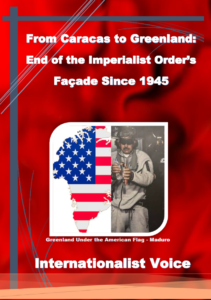
Greenland is an autonomous territory of Denmark, and for over a year, Donald Trump has repeatedly emphasised Greenland’s strategic importance for the United States’ national security, calling for its annexation by the US. He has even recently appointed Jeff Landry, the Governor of Louisiana, as his special representative on Greenland affairs. Continuing this pressure, following the US attack on Venezuela, Katie Miller, the wife of Trump’s Deputy Chief of Staff, posted an image of Greenland in the colours of the American flag on 3 January, with the simple caption: “Soon.”
Trump claims that Greenland is surrounded by Russian and Chinese ships and that Denmark is unable to ensure the island’s security. From this perspective, he believes that, in order to protect imperialist interests and secure the United States’ hegemony over strategic regions, it is essential for Greenland to be annexed by the US, and in this regard he says:
“We need Greenland for national security, not for minerals…We need Greenland for national security. And if you take a look at Greenland, you look up and down the coast, you have Russian and Chinese ships all over the place. We need it for national security. We have to have it…Greenland’s a big deal.”[6]
After the United States’ decision to seize Greenland sparked concerns among European countries, the White House announced that, despite European opposition, Donald Trump is exploring a ‘range of options’ for Greenland’s annexation:
“President Donald Trump is discussing options for acquiring Greenland, including potential use of the U.S. military, in a revival of his ambition to control the strategic island despite European objections.”[7]
The issue of Greenland has become a serious dilemma for Europe, and the rift between Europe and the United States is widening by the day. A NATO member and traditional European ally is now attempting to bring part of another NATO member—which is also a US ally—under its control, an action that demonstrates that each power actor is pursuing its own imperialist interests, and that the alliance between the US and Europe faces a serious challenge. The Danish Prime Minister, referring to his country’s membership, and consequently Greenland’s, in the North Atlantic Treaty Organization (NATO), stated:
“If the U.S. chooses to attack another NATO country militarily, then everything stops, including NATO and thus the security that has been established since the end of the Second World War.”[8]
Politico[9] has spoken with nine European Union officials, NATO internal sources, defence experts, and diplomats to examine how the United States’ takeover of Greenland—a strategically important island rich in mineral resources—might proceed. The stages outlined indicate that each of the “gangsters,” in pursuit of their objectives, resorts to intrigue and aggressive actions, even against their own allies, much like pirates. In other words, under such circumstances, international law is rendered effectively meaningless, and there is no obligation to observe it. This media outlet has described the potential process of Greenland’s takeover in four distinct stages:
- Step 1: Influence campaign to boost Greenland’s independence movement
- Step 2: Offer Greenland a sweet deal
- Step 3: Get Europe on board
- Step 4: Military invasion
In fact, both the operation to abduct Maduro and the plan to seize Greenland demonstrate that the United States is pursuing its strategic interests. These actions should be analysed within the framework of the competition for global capitalist hegemony between the United States and China. The United States’ primary objective is to curb China’s growing influence, particularly in Latin America.
In pursuing its strategic interests—that is, weakening its rivals and containing China—the United States is even willing to turn on its own allies and stab them in the back. This approach also serves as a serious warning to Europeans who consider themselves US allies.
To put it more precisely, in the context of the new chaos in the global system, although the United States’ strategic objective is to weaken China, this goal is for now pursued not through direct confrontation with China, but by undermining its allies and restricting its spheres of influence. Europe, which has provided significant support to the United States in the past and remains its ally, now feels that it has been stabbed in the back.
The new global conditions have led the United States to conclude that there is no longer any necessity to adhere to imperialist international rules. In this situation, not only is there no need for bourgeois pretence, but at the heart of this chaos, the “law of the jungle” prevails—where only force determines outcomes. The consequences of this escalating, tension-fuelling competition can be observed in every corner of the world, a trend that will undoubtedly intensify day by day.
In such circumstances, the task of internationalists is to expose the imperialist nature of these tensions, in which all the states involved act as imperialist and reactionary forces. These conflicts fuel an escalating arms race among criminal governments—a race that is only sustainable through a war economy. The costs of this war economy are borne by capitalist states and imposed through austerity policies; put plainly, it is the working class that pays the price for these tensions and acts of warmongering.
History has shown that the only force capable of ending the bourgeoisie’s killing machine—war—is the working class. It was the danger of revolution in Germany during the First World War that forced the bourgeoisie to sign the armistice. This principle is always true: war criminals only cease their wars in the shadow of the proletariat’s danger, in order to prepare themselves for a class war against the proletariat. Although the global working class is not currently in such a position, the development of the class struggle could create such a horizon for the proletariat.
The expansion of regional wars and the increase in military tensions are a direct product of the current conditions of capitalism; in other words, they result from the particular mode of existence and persistence of capitalism in its phase of decline. Capitalism brings humanity nothing but further wars and escalating barbarism. In the era of capitalist decay, war has become an integral part of the way of life and existence under capitalism.
Capitalism is incapable of offering any constructive vision for the future and can only spread savagery and barbarism to more regions of the world. In response to this situation, only the class struggle of the working class can offer a real alternative to the barbarity of capitalism. The proletariat has no country to defend, and its struggle must inevitably transcend national borders and expand on an international scale.
Only the global working class, by turning capitalism’s wars into a war against capitalism itself and ultimately overthrowing the system on a global scale, can eliminate the material foundations of military tensions and imperialist wars, and bring lasting peace to humanity.
Long Live the War Between the Classes!
F.A.
11 January 2026
Notes:
[3] For a clearer analysis of the current global situation, it is recommended to study the booklet “The Shifting Balance of Imperialist Powers and the Recomposition of the World Order: The Necessity of Independent Proletarian Organisation.”
[6] US needs Greenland for national security: Trump.
Downlaod as PDF